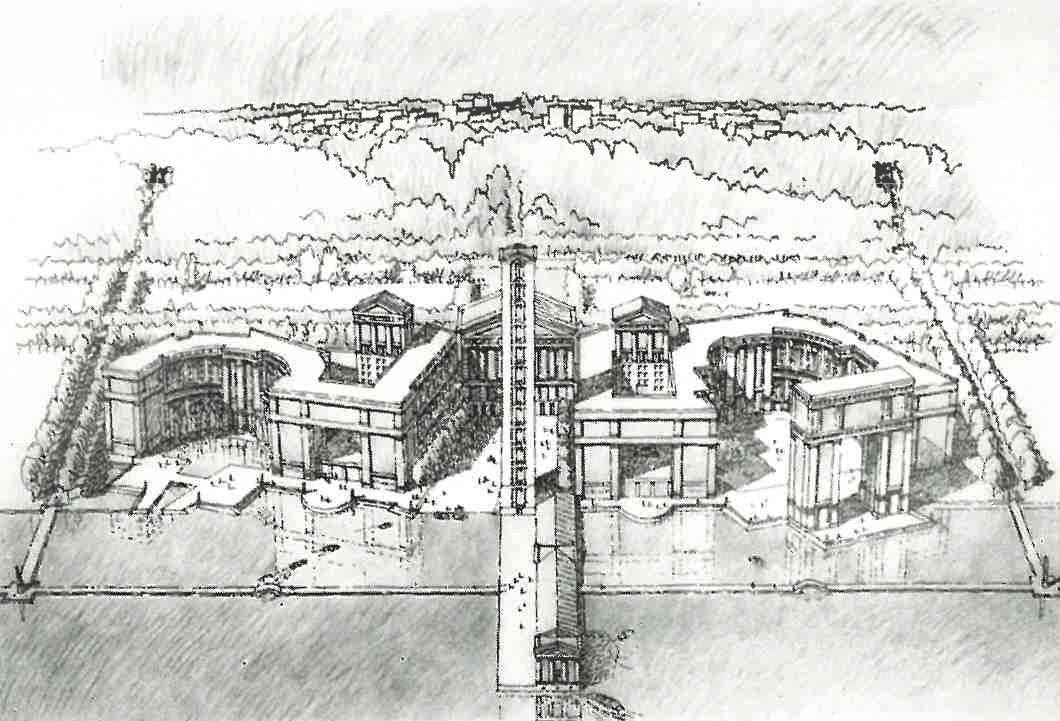
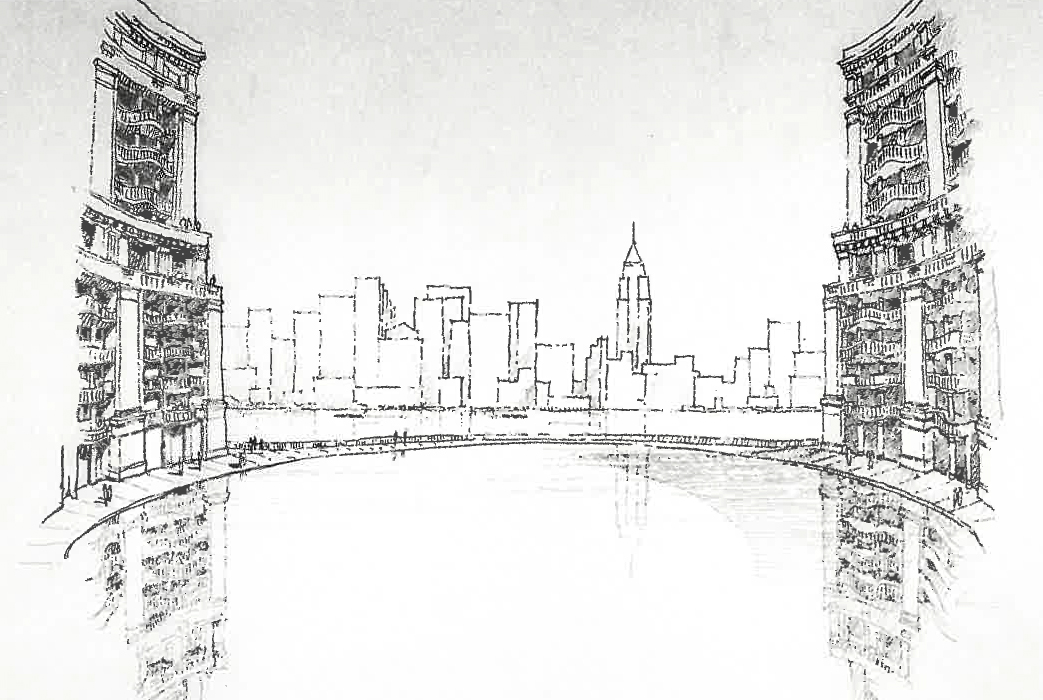
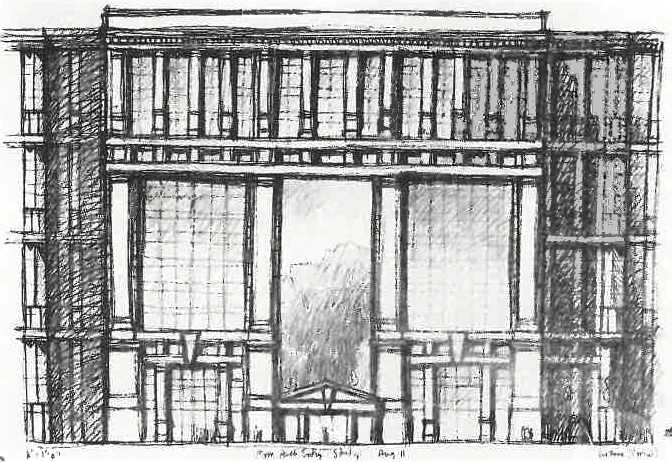
In a location comparable to Palladio’s Redentore in front of Piazza San Marco, or any island facing the city of Venice, this housing scheme for potentially 2,000 apartment units, with retail, parking, and sports facilities, looks directly across the Hudson River to the most famous skyline in the world: Manhattan. The challenge of building on the left bank of the Hudson is similar to the one Renaissance architects faced when building on La Giudecca, where size, scale, and proportions became dramatically distorted.
En una ubicación comparable al Redentore de Palladio frente a la Piazza San Marco, o cualquier isla frente a la ciudad de Venecia, este proyecto de viviendas para potencialmente 2000 apartamentos, con locales comerciales, aparcamiento e instalaciones deportivas, mira directamente al otro lado del río Hudson hacia el horizonte más famoso del mundo: Manhattan. El reto de construir en la orilla izquierda del Hudson es similar al que afrontaron los arquitectos renacentistas al construir en La Giudecca, donde el tamaño, la escala y las proporciones se distorsionaron drásticamente.
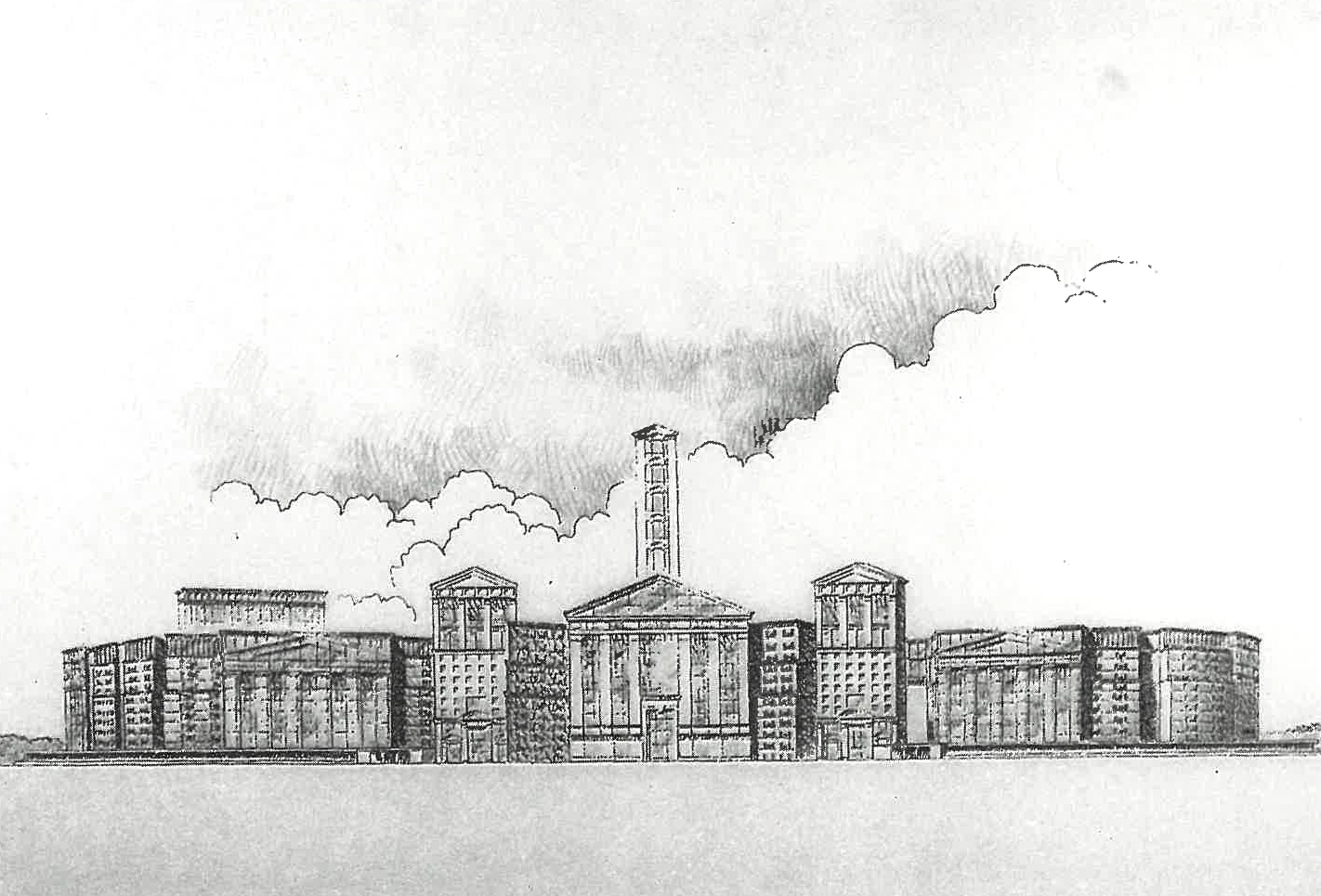
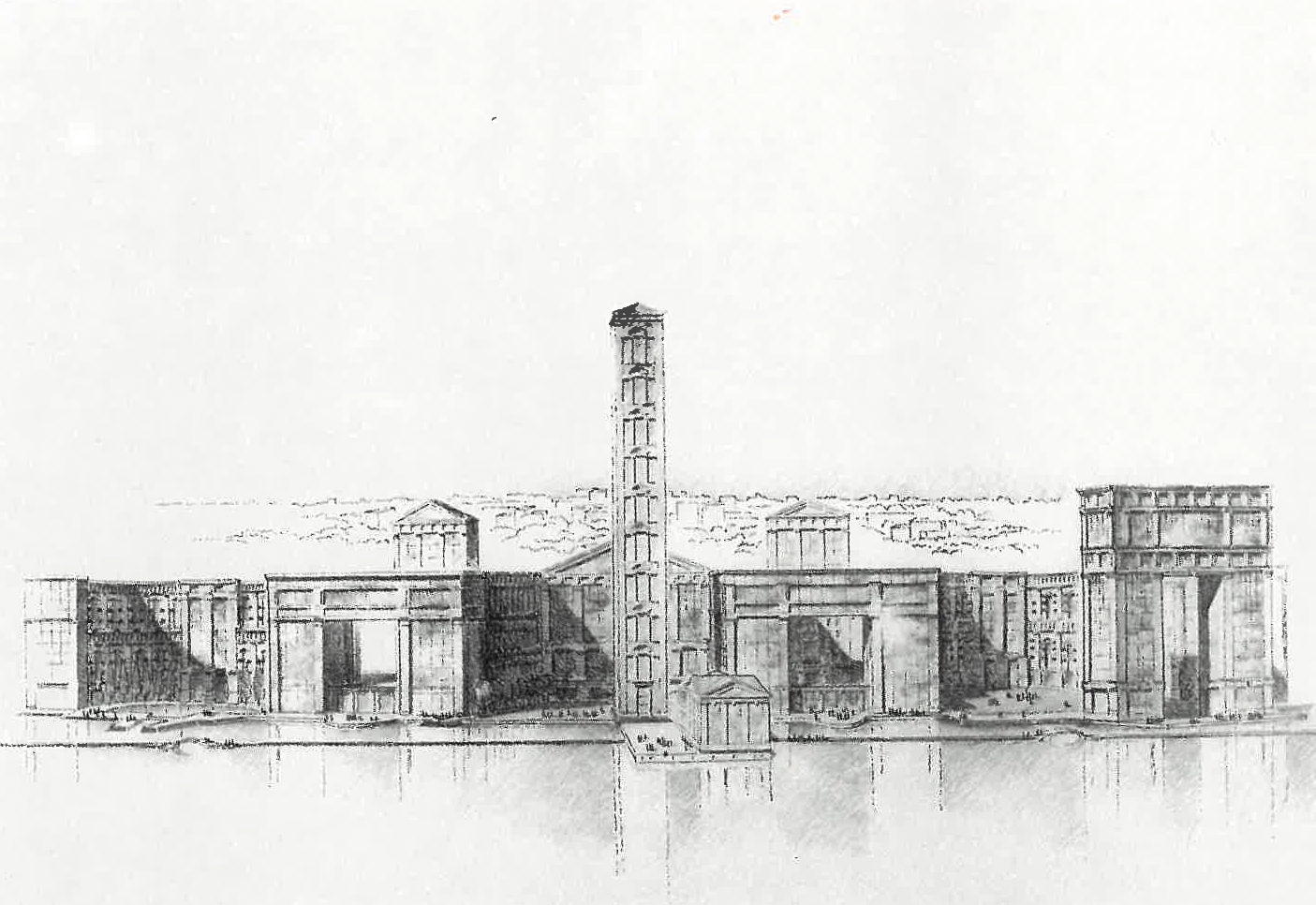
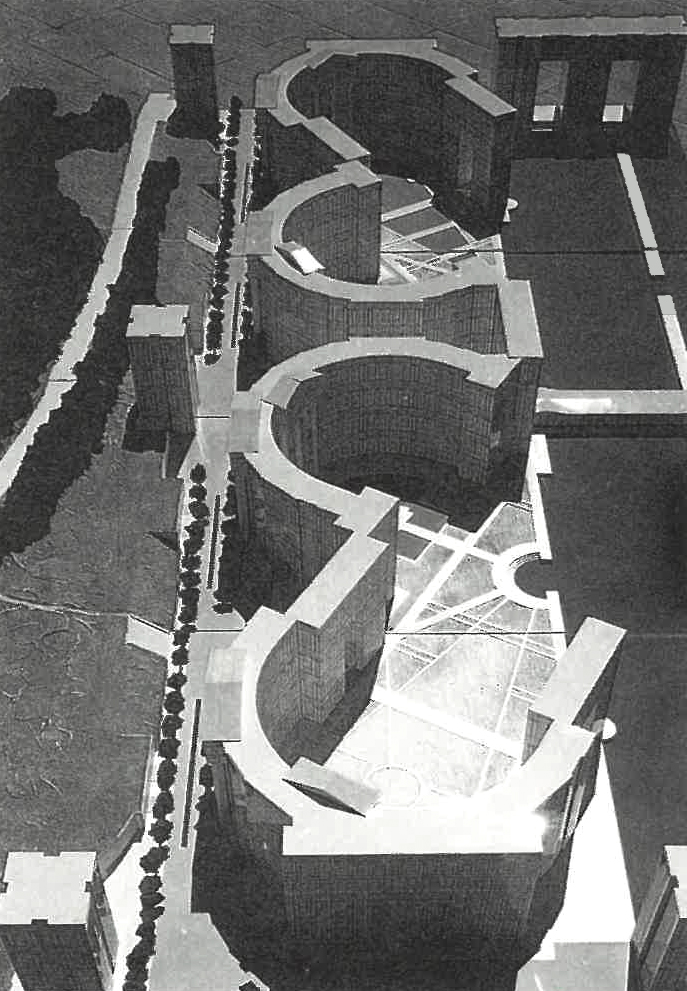
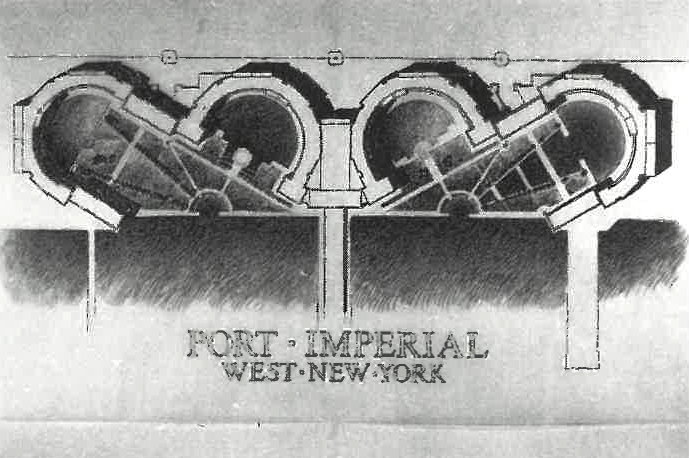
A first phase of 700 units is conceived as a palace with its back against the 170-foot cliff of the New Jersey Palisades. This palace is carved like a huge rock with three piazzas, each looking specifically at remarkable features of the city: Downtown to the south, Midtown perpendicularly across the river, and the Upper West Side with Riverside Park to the north. Each plaza is laid out with a precise structural geometry, giving them a central focus as well as tying them together into one massive building. The back of the building is seen as a broken but well-composed wall where two taller towers mark the entrance to two atriums that distribute circulation throughout the building. The front, with its three open spaces, looks at the ever-changing scenery of the city and the river, the skyscrapers reflecting sunrise, daylight, sunset, and their glowing interiors at night.
La primera fase, de 700 viviendas, se concibe como un palacio con la espalda apoyada en el acantilado de 52 metros de las Palisades de Nueva Jersey. Este palacio está tallado como una enorme roca con tres plazas, cada una de las cuales ofrece vistas específicas de los lugares más destacados de la ciudad: el centro al sur, Midtown perpendicularmente al otro lado del río y el Upper West Side con Riverside Park al norte. Cada plaza está diseñada con una geometría estructural precisa, lo que les da un enfoque central y las une en un único edificio masivo. La parte trasera del edificio se ve como un muro roto pero bien compuesto, donde dos torres más altas marcan la entrada a dos atrios que distribuyen la circulación por todo el edificio. La parte delantera, con sus tres espacios abiertos, mira hacia el paisaje siempre cambiante de la ciudad y el río, los rascacielos que reflejan el amanecer, la luz del día, el atardecer y sus interiores brillantes por la noche.
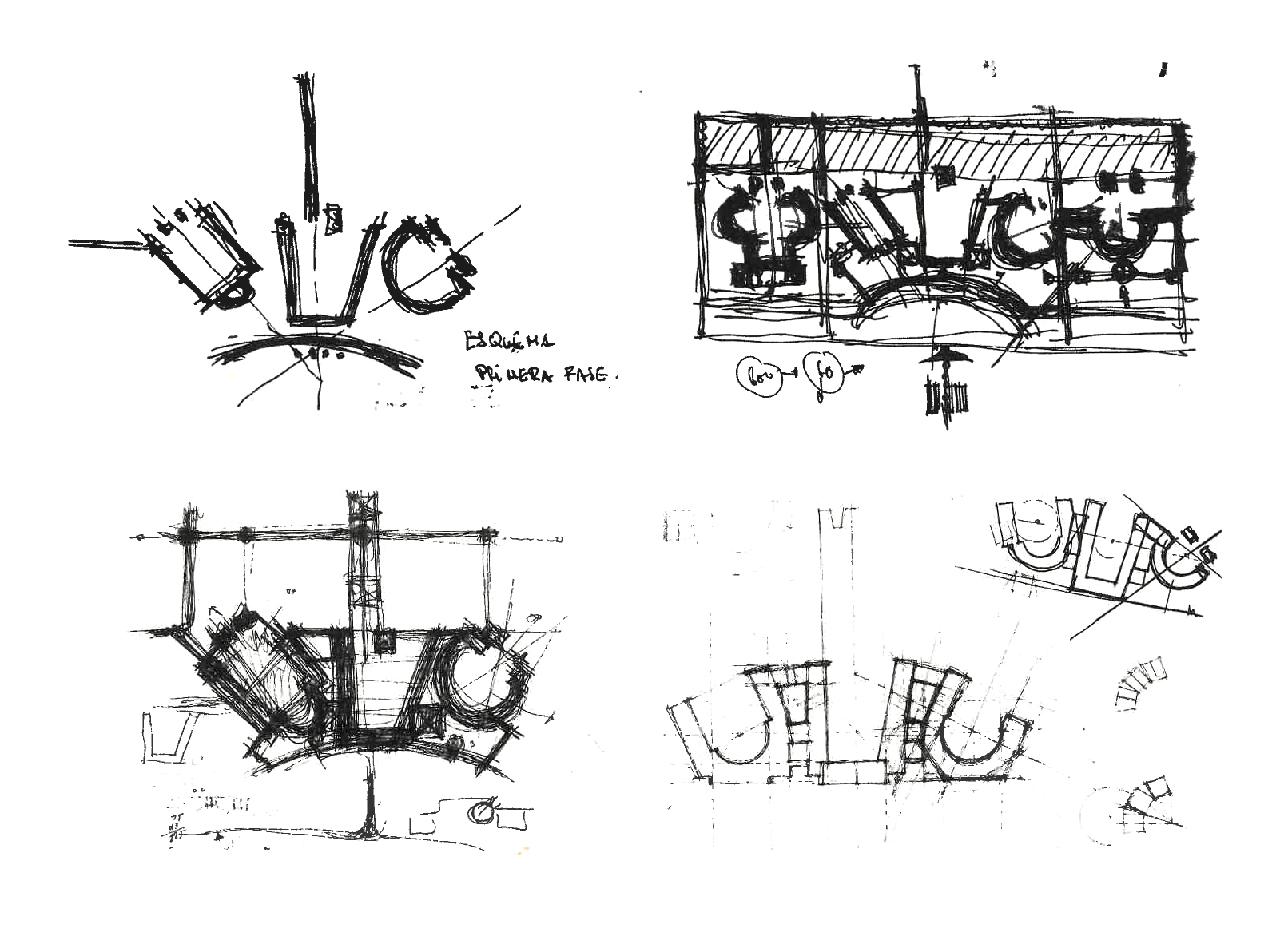
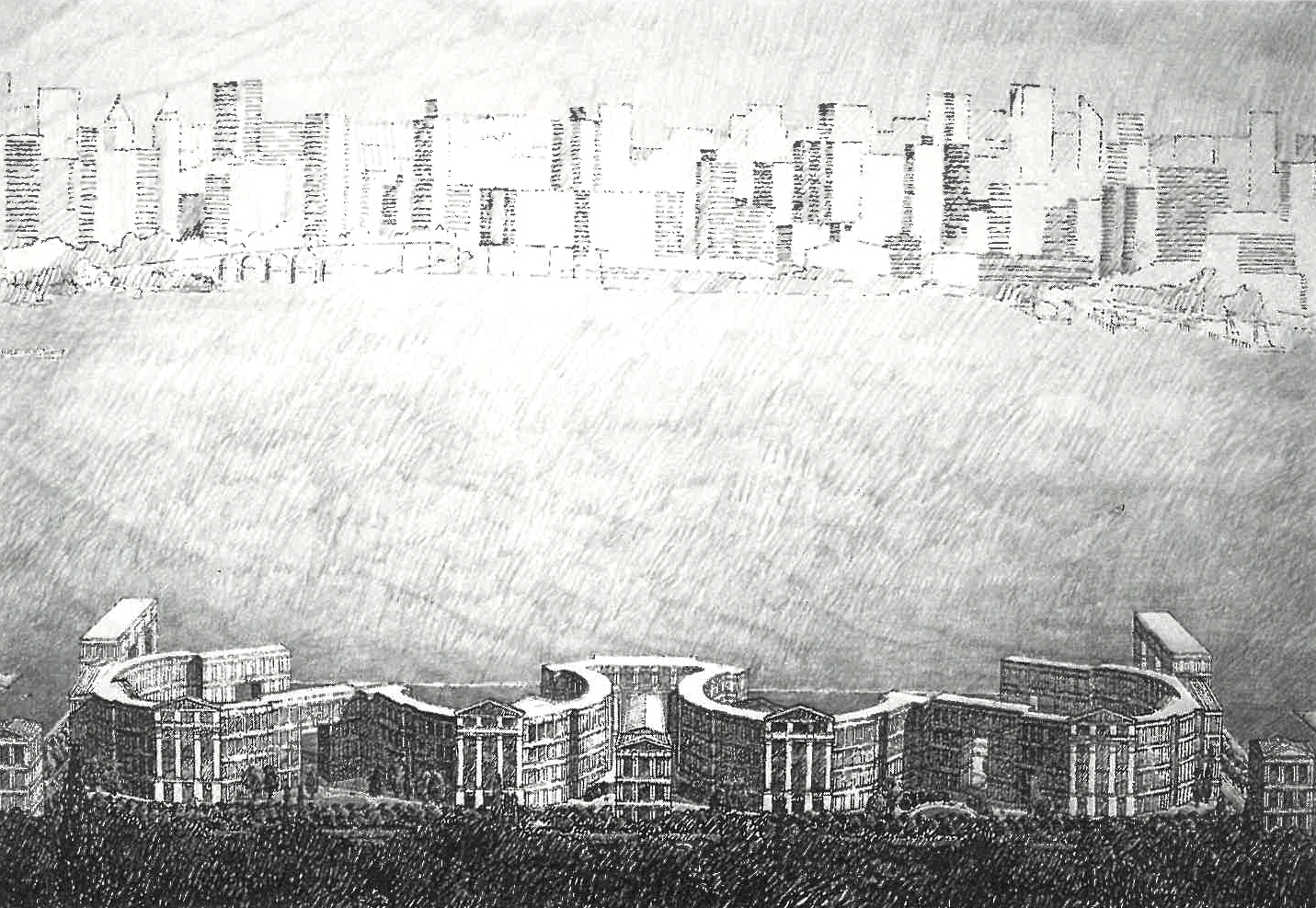
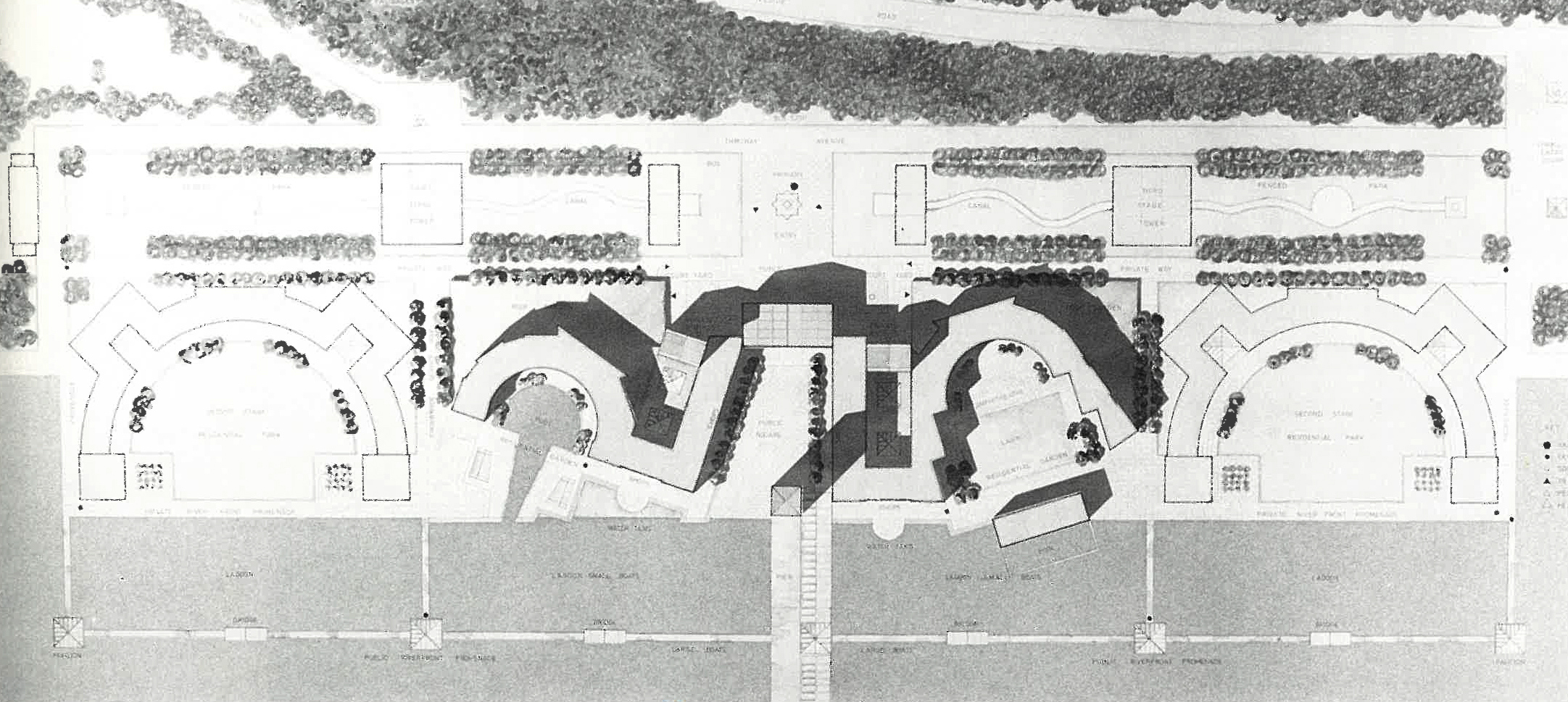
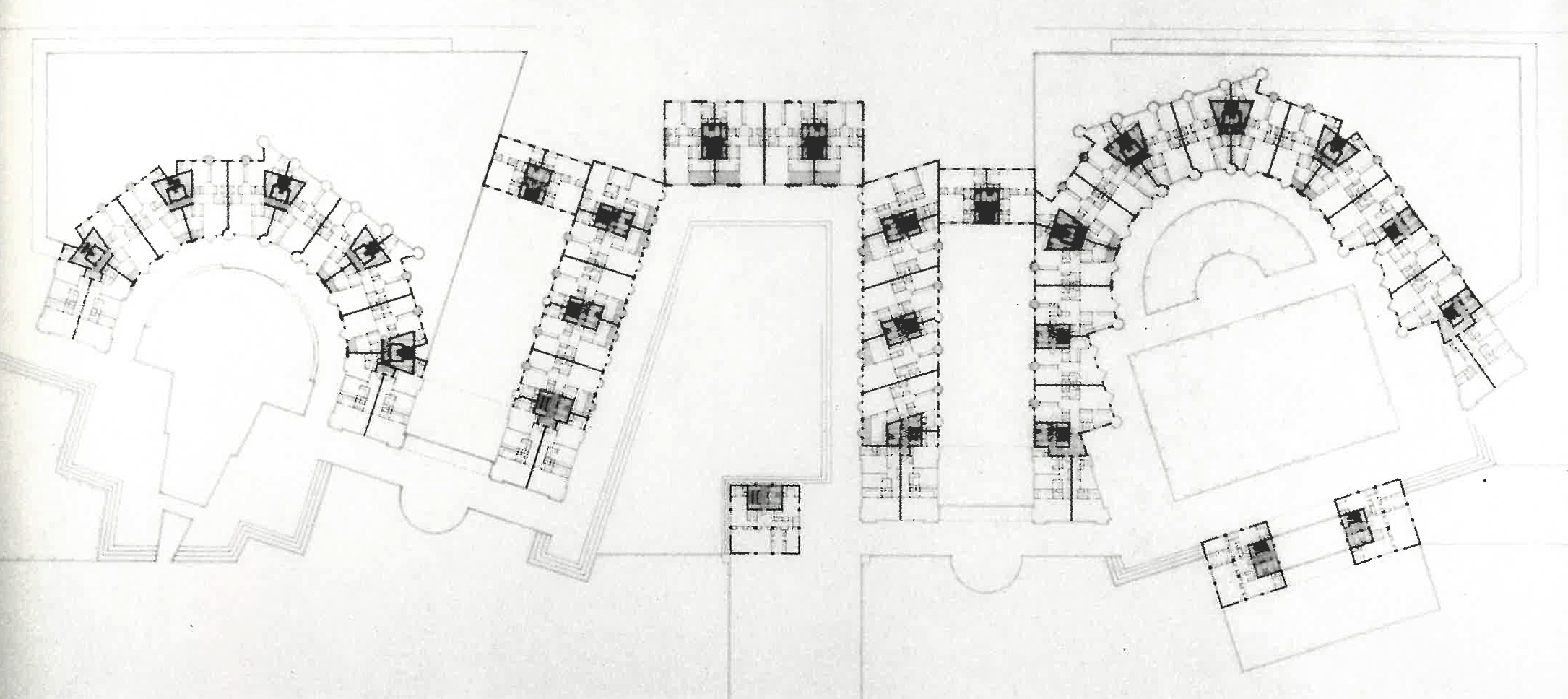
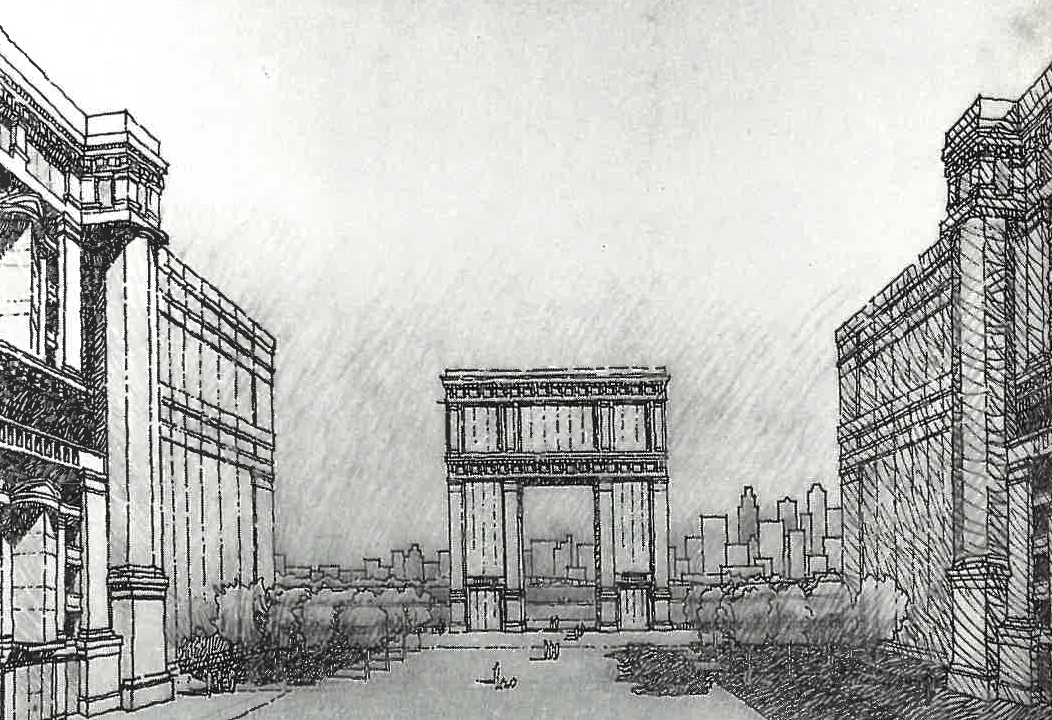
The central public space receives residents and visitors onto a pier (from where they may take a four-minute ferry ride across the river), which is the actual central axis of this space. The two buildings on either side of the plaza embrace its paved expanse with a double-story shopping arcade, at the end of which a red temple-like building marks the center of this entire phase. A campanile tower, placed off-axis, helps to provide scale while framing the views.
El espacio público central recibe a los residentes y visitantes en un muelle (desde donde pueden tomar un ferry que cruza el río en cuatro minutos), que es el eje central real de este espacio. Los dos edificios a ambos lados de la plaza abrazan su extensión pavimentada con una galería comercial de dos pisos, al final de la cual un edificio rojo similar a un templo marca el centro de toda esta fase. Una torre campanario, situada fuera del eje, ayuda a proporcionar escala al tiempo que enmarca las vistas.
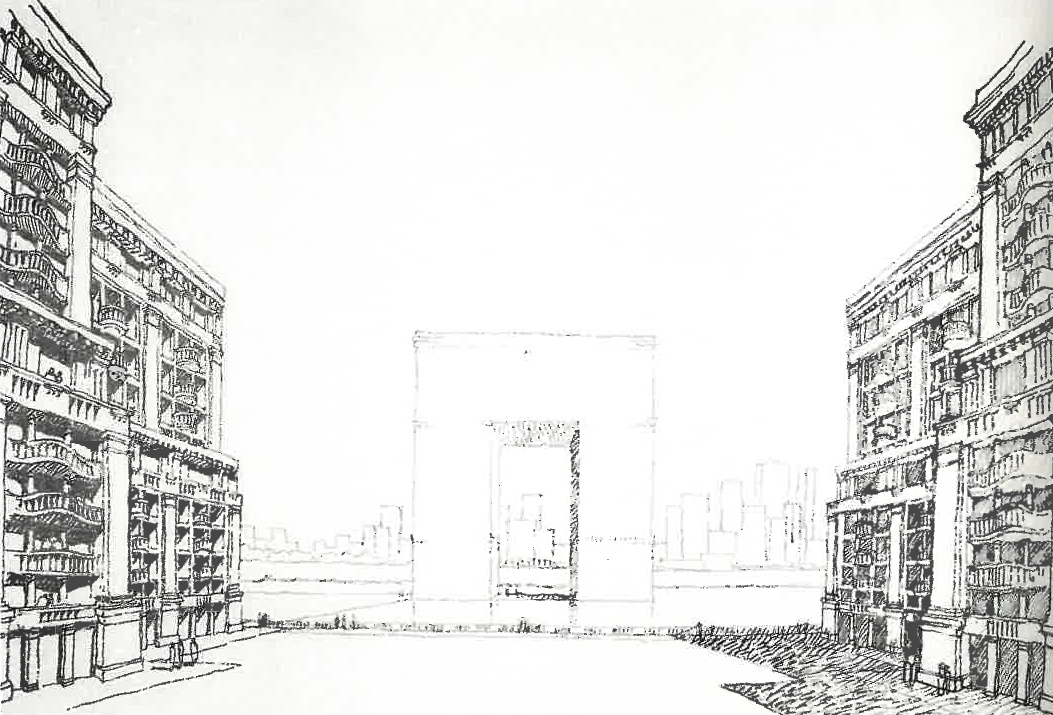
The other two plazas on either side are designed as contemplative, residential, private spaces open to the city views. The south plaza has the shape of a theater, oriented toward Midtown, and a plane of still water above the glittering ripples of the Hudson will reflect the buildings’ facade, which is composed of three orders of glass columns (bow windows) interrupted in the middle by a three-column temple front. The north plaza opens up so that individual views are improved in all directions, and a glass triumphal arch building acting as the arrière-scene will frame different pictures of the overwhelming landscape when viewed in its totality.
Las otras dos plazas a ambos lados están diseñadas como espacios contemplativos, residenciales y privados abiertos a las vistas de la ciudad. La plaza sur tiene forma de teatro, orientada hacia Midtown, y un plano de agua tranquila sobre las brillantes ondas del Hudson reflejará la fachada de los edificios, compuesta por tres órdenes de columnas de cristal (ventanas saledizas) interrumpidas en el centro por un frente de templo de tres columnas. La plaza norte se abre para mejorar las vistas individuales en todas las direcciones, y un edificio con un arco triunfal de cristal que actúa como telón de fondo enmarcará diferentes imágenes del impresionante paisaje cuando se contemple en su totalidad.
Text by Jean-Pierre Carniaux, transation by Hidden Architecture