El Correo is a series that compiles the informal and playful exchange of letters between the editors of Hidden Architecture, defining a contingent editorial line.
El Correo es una serie que recopila el intercambio epistolar, informal y lúdico, entre los editores de Hidden Architecture, definiendo una línea editorial contingente.
***
An old Tibetan legend tells of sharp flute sounds flying on the wind between the peaks of these mountains. Trashi Puntso spurs his mount, a brave steed called Swift Dragon, across the endless expanse of the high plain. At the horse’s feet the ground sinks, damp and half-frozen, as if it wanted to swallow the animal and its rider.
Cuenta una vieja leyenda tibetana que afilados sones de flauta volaban a lomos del viento entre las cumbres de estas montañas. Trashi Puntso espolea su montura, un bravo corcel que se hace llamar Dragón Veloz, por la extensión infinita de la alta llanura. A pies del caballo la tierra se hunde, húmeda y medio congelada, como si quisiera tragarse al animal y su jinete.
Legend has it that the last gallop shared by Trashi Puntso and Swift Dragon was futile, that the skilled nomadic horse breeder failed to rescue Yuchung Meto from the whirlwind that carried her away, snatching her from her village like a weak reed to the hidden reaches of this vast plain of ice and mud.
Cuenta la leyenda que la última galopada compartida por Trashi Puntso y Dragón Veloz resultó fútil, que el hábil nómada criador de caballos no consiguió rescatar a Yuchung Meto del remolino de viento que se la llevó, arrancándola de su aldea como un débil junco hasta los confines ocultos de esta inmensa llanura de hielo y barro.
Legend also has it that the gruelling rigour of the snow-capped peaks separated Trashi Puntso and Swift Dragon, and that man and horse never again embraced in brotherly love in that life. As a result of this failure, of this desperate flee towards the longing for an impossible rescue, the eternal waters of this river flow today – in reality, of any other river – persistently crossing the lands of the roof of the world.
Cuenta la leyenda, también, que el fatigoso rigor de las cumbres nevadas separó a Trashi Puntso y Dragón Veloz, que hombre y caballo no volvieron a fundirse en fraternal abrazo en aquella vida. Como fruto de este fracaso, de esta huida desesperada hacia el anhelo de un rescate imposible, fluyen hoy las aguas eternas de este río – en realidad, de cualquier otro río – que atraviesa persistentemente las tierras del techo del mundo.
The legend concludes by saying that once the force of the wind that swept away the young woman, now lost forever, had subsided, three tall mountains formed a triangle under the sky, flanking the riverbed. Standing tall in stony vigilance, Trashi Puntso, Yuching Meto and Swift Dragon have watched over the waters ever since, ensuring that they never stop flowing.
Cuenta la leyenda, a modo de conclusión, que apagada la fuerza del viento que arrastró a la joven, perdida ya para siempre, tres altas montañas dibujaron un triángulo bajo el cielo, flanqueando el cauce del río. Erguidos en pétrea vigilancia, Trashi Puntso, Yuching Meto y Dragón Veloz vigilan desde entonces que las aguas no dejen de fluir.
Dorje Phagmo is the lama who runs Sanding Si Monastery, located at an altitude of over 4,500 metres near the southern shore of Yandrok-tso, one of Tibet’s four sacred lakes, famous for the turquoise reflections of its waters. It is exceptional for a woman to lead a Buddhist community, but Dorje Phagmo takes it in her stride, almost as if it were her daily routine to energetically sweep each of the monastery’s courtyards.
Dorje Phagmo es la lama que dirige el monasterio de Sanding Si, a más de 4500 metros de altura y cerca de la orilla meridional del Yandrok-tso, uno de los cuatro lagos sagrados del Tibet, afamado por los reflejos turquesa de sus aguas. Que una mujer dirija una comunidad budista es un hecho excepcional, pero Dorje Phagmo lo asume con una naturalidad apabullante, casi como su costumbre cotidiana de barrer enérgicamente cada uno de los patios del monasterio.
For her, the figure of Trashi Puntso is deeply familiar, like a distant cousin with whom one maintains a closer relationship than usual. Aware since childhood of the misfortune of his heroic quest, she shows no qualms about expressing her scepticism regarding its outcome. Many believe that his spirit was reincarnated forever in that mountain by the river, she says, raising her forehead delicately. However, I have seen him wandering around the monastery, always on moonless nights.
Para ella la figura de Trashi Puntso resulta profundamente familiar, como una especie de primo lejano con el que se mantiene una relación más estrecha de lo habitual. Conocedora, desde pequeña, de la mala fortuna de su heroica búsqueda, muestra sin reparos un abierto escepticismo en relación a su final. Muchos creen que su espíritu se reencarnó para siempre en aquella montaña junto al río, indica alzando delicadamente la frente. Sin embargo, yo le he visto vagar errante alrededor del monasterio, siempre en las noches sin luna.
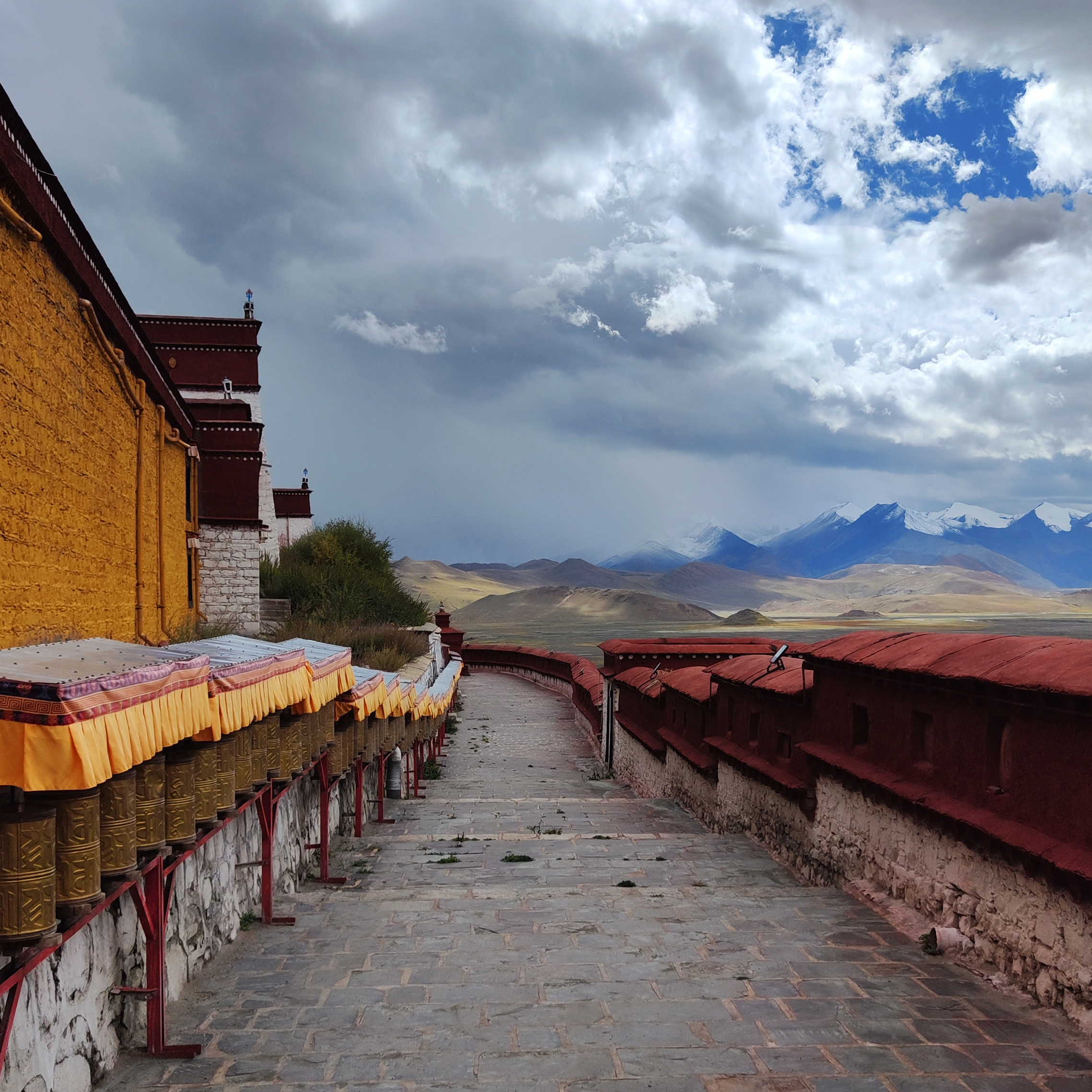
The Sangding Si Monastery consists of a group of buildings arranged around two large courtyards, which house the main functions of monastic life for the monks who still live there. As is usual in Tibetan Buddhist temple architecture, the monastery is surrounded by a walkway which, in this case, forms a panoramic gallery open to the surroundings. This is the chora, and it is the mandatory route that pilgrims visiting the monastery must take before entering it, always in a clockwise direction. This transitional space between the exterior and interior considerably extends the moment of entry into the monasteries, linking the physical experience with the spiritual experience of prayer. Depending on the magnitude of the prayers offered, pilgrims walk the chora in different ways. Most will walk at a brisk pace, singing and praying while spinning the manis, the cylindrical prayer wheels that accompany the walk to the rhythm of the mantra Om Mani Padme Hum. Others drag themselves painfully along the ground, tracing a rhythmic and exhausting choreography of genuflection, reaching a trance where body, architecture and prayer merge into a mystical state of being.
El Monasterio de Sangding Si se compone de un conjunto de edificios ordenados en torno a dos patios de grandes dimensiones, que acogen las funciones principales de la vida monástica de los monjes que todavía lo habitan. Como es habitual en la arquitectura tibetana de los templos budistas, el monasterio está rodeado por un paseo que, en este caso, constituye una galería perimetral panorámica abierta al entorno. Se trata de la chora, y constituye el recorrido obligatorio que deben realizar los peregrinos que visitan el monasterio antes de acceder a él, siempre en el sentido de las agujas del reloj. Este espacio de transición entre exterior e interior dilata considerablemente el instante de acceso a los monasterios, vinculando la experiencia física con la experiencia espiritual del rezo. En función de la magnitud de las plegarias emitidas, los peregrinos recorren la chora de diferentes maneras. La mayoría lo harán caminando a ritmo intenso, cantando y rezando mientras hacen girar las manis, las ruedas de plegarias cilíndricas que acompañan el recorrido a ritmo del mantra Om Mani Padme Hum, Otros se arrastran penosamente por el suelo, trazando una rítmica y agotadora coreografía de genuflexión, alcanzando un trance donde cuerpo, arquitectura y rezo se funden en un estado místico del ser.
Dorje Phagmo cleans, stubbornly polishing the aged golden surfaces, each of the manis that mark the path of the chora. Before the first pilgrims arrive at the monastery from the nearby villages, she removes the blackened remains of yak butter that were deposited yesterday as offerings. With extreme care in every action she performs, a maternal smile on her rugged, wrinkled face, she traces the circular path of the chora, her eyes constantly alert to a sky covered with increasingly dark clouds. In the background, bordering the plain on its southern flank, the first foothills of the Himalayas are dressed in a sad violet colour which, at this time of the morning, intensifies the haze that is beginning to hide the whiteness of their peaks.
Dorje Phagmo limpia, obstinándose en abrillantar sus avejentadas superficies doradas, cada una de las manis que trazan el recorrido de la chora. Antes de que los primeros peregrinos acudan al monasterio desde las aldeas cercanas, retira los restos ennegrecidos de mantequilla de Yak que fueron ayer depositados como ofrenda. Con un gesto de extremo cuidado en cada acción que ejecuta, una sonrisa maternal en su recio rostro surcado de arrugas, traza el recorrido circular de la chora alzando la vista en constante alerta por un cielo que se cubre de nubes cada vez más negras. Al fondo, limitando la llanura en su flanco sur, las primeras estribaciones del Himalaya se visten de un triste violeta que, a esta hora de la mañana, aviva la veladura que comienza a ocultar la blancura de sus picos.
On winter nights, she relates curiously, when in almost complete darkness only the stars above and the snow-capped peaks twinkle with a faint glow, a strange whistling wind comes from the plain, reminding us all of ancestral flute laments.
En las noches de invierno, relata curiosa, cuando en la oscuridad casi absoluta sólo las estrellas en lo alto y las cumbres nevadas centellean con un tímido resplandor, llega desde la llanura un extraño silbido de viento que a todas nos recuerda a lamentos ancestrales de flauta.
Héctor Rivera Bajo
26th January 2026
***
El Correo is conceived as a playful act of exchanging ideas in writing, a random attempt to establish a dialogue at a distance, reflecting shared interests in the relationship between travel and architecture. Like any game, it is governed by a series of basic rules that determine the margins of its action. Four rules are fixed, while the last one is temporary and will be modified every time a cycle of 7 postal exchanges is completed.
El Correo se plantea como un acto lúdico de intercambio de ideas por escrito, un intento azaroso de establecer un diálogo en la distancia, reflejando intereses compartidos sobre la relación entre viaje y arquitectura. Como todo juego, se rige por una serie de reglas básicas que determinan los márgenes de su acción. Cuatro reglas son fijas, mientras que la última es temporal y será modificada cada vez que se cumpla un ciclo de 7 intercambios postales.
- The postcard must make direct reference to an experience lived in the first person by the author of the postcard.
- Each postcard will be illustrated with a photograph taken by the author.
- The text should not exceed 500 words.
- Each postcard must respond to the previous one in a concrete way within 30 days, creating a kind of domino effect.
- The theme of the first series of 7 postcards will be the transition between outer and inner space.
- La postal debe hacer referencia directa a una experiencia vivida en primera persona por el autor de la misma.
- Cada postal se ilustrará con una fotografía propia del autor.
- La extensión del texto no excederá las 500 palabras.
- Cada postal debe responder en un plazo de 30 días, de forma concreta, a la anterior, determinando una suerte de efecto dominó.
- El tema de la primera serie de 7 postales será la transición entre el espacio exterior y el interior.