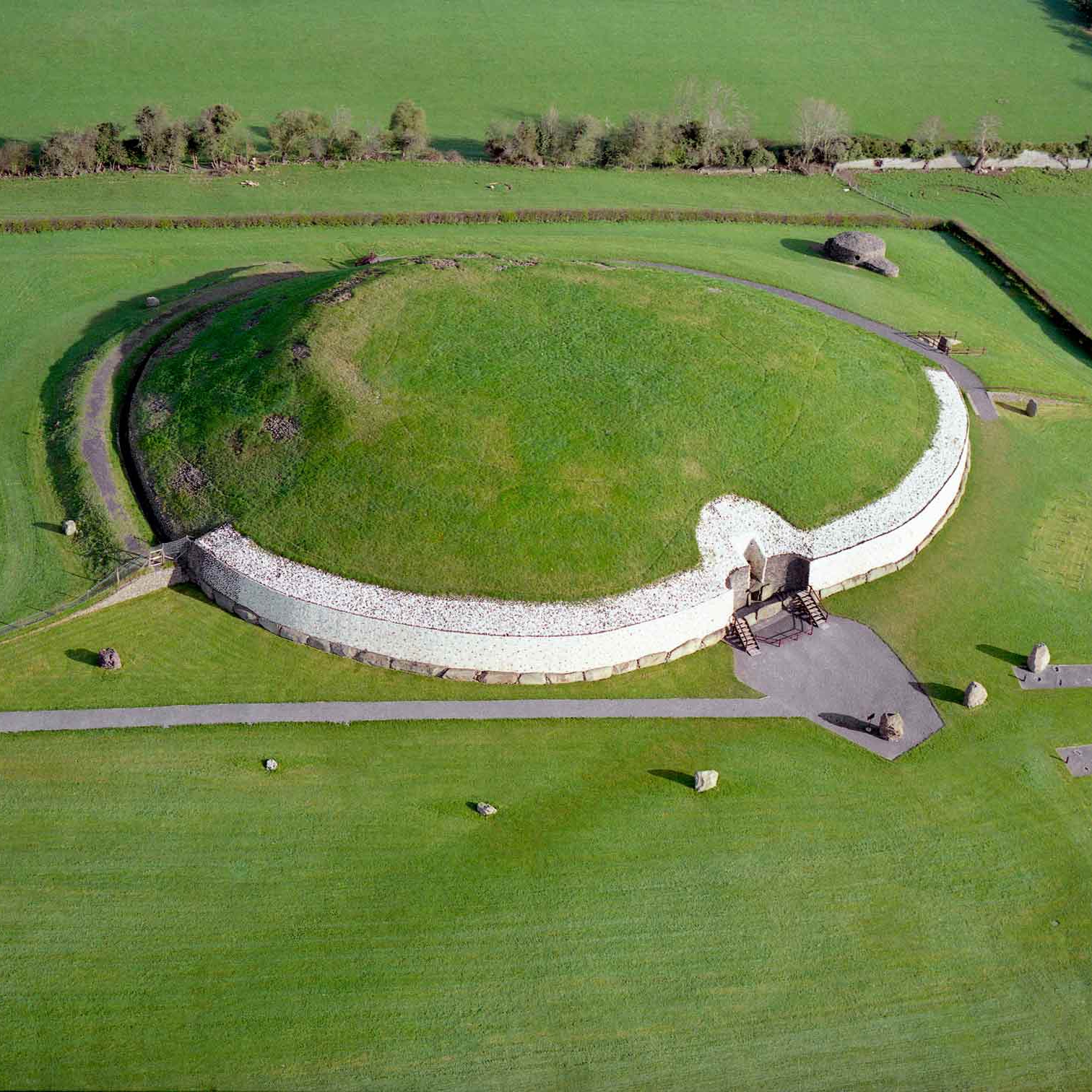
Ireland is particularly rich in megalith tombs, having over 500 documented sites. Constructing these communal graves for cremated or skeletal remains seems to have been not only an expression of reverence for ancestors but also a means of establishing claims to land, and megalith tombs are frequently located on prominent sites. Among the most impressive is the passage grave at Newgrange, County Meath, built about 3100 BCE on the crest of a hill overlooking the Boyne river. An earthen mound nearly 300 feet in diameter and thirty-six feet high covers the tomb, with the weight of the soil providing stability for the megaliths below. Decorated boulders surround the perimeter of the mound. (The white quartz facing is a modern reconstruction based on excavations, providing visibility from a distance.) The south-facing entry leads to a sixty-two-foot-long, upward-sloping passage covered by stone lintels terminating in a cruciform chamber covered by a beehive corbeled ceiling twenty feet high. Parts of the stonework in the passage and chamber are decorated with incised patterns, including diamond shapes and spirals, whose meanings are unknown. The whole construction is carefully oriented so that, in the five days around the winter solstice, light from the rising sun enters through the doorway and a transom-like light box creeps along the passage and illuminates the chamber within for about fifteen minutes. To those fortunate enough to witness this annual event (the only time there is any light in the interior), the effect is magical and very moving. Constructing such a massive tomb (and there are two others on the same scale nearby) would have required sustained effort over many years. Available technology provided nothing harder than copper or bronze tools for shaping stone, and there were no wheeled vehicles or draft animals to assist with transport. Nonetheless, ancient builders made the necessary astronomical observations and organized a work force sufficient to maneuver stones weighing up to five tons.
Irlanda es particularmente rica en tumbas megalíticas, con más de 500 yacimientos documentados. La construcción de estas tumbas comunes para restos cremados o óseos parece haber sido no solo una expresión de reverencia a los antepasados, sino también una forma de establecer derechos territoriales, y las tumbas megalíticas se ubican con frecuencia en lugares prominentes. Entre las más impresionantes se encuentra la tumba de corredor de Newgrange, en el condado de Meath, construida alrededor del 3100 a. C. en la cima de una colina con vistas al río Boyne. Un montículo de tierra de casi 90 metros de diámetro y 11 metros de altura cubre la tumba, y el peso del suelo proporciona estabilidad a los megalitos que se encuentran debajo. Cantos rodados decorados rodean el perímetro del montículo. (El revestimiento de cuarzo blanco es una reconstrucción moderna basada en excavaciones, lo que permite su visibilidad a distancia). La entrada, orientada al sur, conduce a un pasaje de 18 metros de largo, con pendiente ascendente, cubierto por dinteles de piedra, que termina en una cámara cruciforme cubierta por un techo con ménsulas en forma de colmena de 6 metros de altura. Partes de la mampostería del pasadizo y la cámara están decoradas con motivos incisos, incluyendo rombos y espirales, cuyo significado se desconoce. Toda la construcción está cuidadosamente orientada de modo que, durante los cinco días que rodean el solsticio de invierno, la luz del sol naciente entra por la puerta y una caja de luz similar a un travesaño se desliza por el pasadizo e ilumina la cámara interior durante unos quince minutos. Para quienes tuvieron la fortuna de presenciar este evento anual (el único momento en que hay luz en el interior), el efecto es mágico y muy conmovedor. Construir una tumba tan enorme (y hay otras dos de la misma escala en las cercanías) habría requerido un esfuerzo sostenido durante muchos años. La tecnología disponible no proporcionaba nada más duro que herramientas de cobre o bronce para tallar la piedra, y no había vehículos con ruedas ni animales de tiro para facilitar el transporte. No obstante, los constructores antiguos realizaron las observaciones astronómicas necesarias y organizaron una fuerza de trabajo suficiente para manipular piedras de hasta cinco toneladas.
Michael Fazio, Marian Moffett, Lawrence Wodehouse, and Owen Hopkins, Buildings Across Time: An Introduction to World Architecture, 6th ed. New York: McGraw-Hill, 2023. 11-12.


