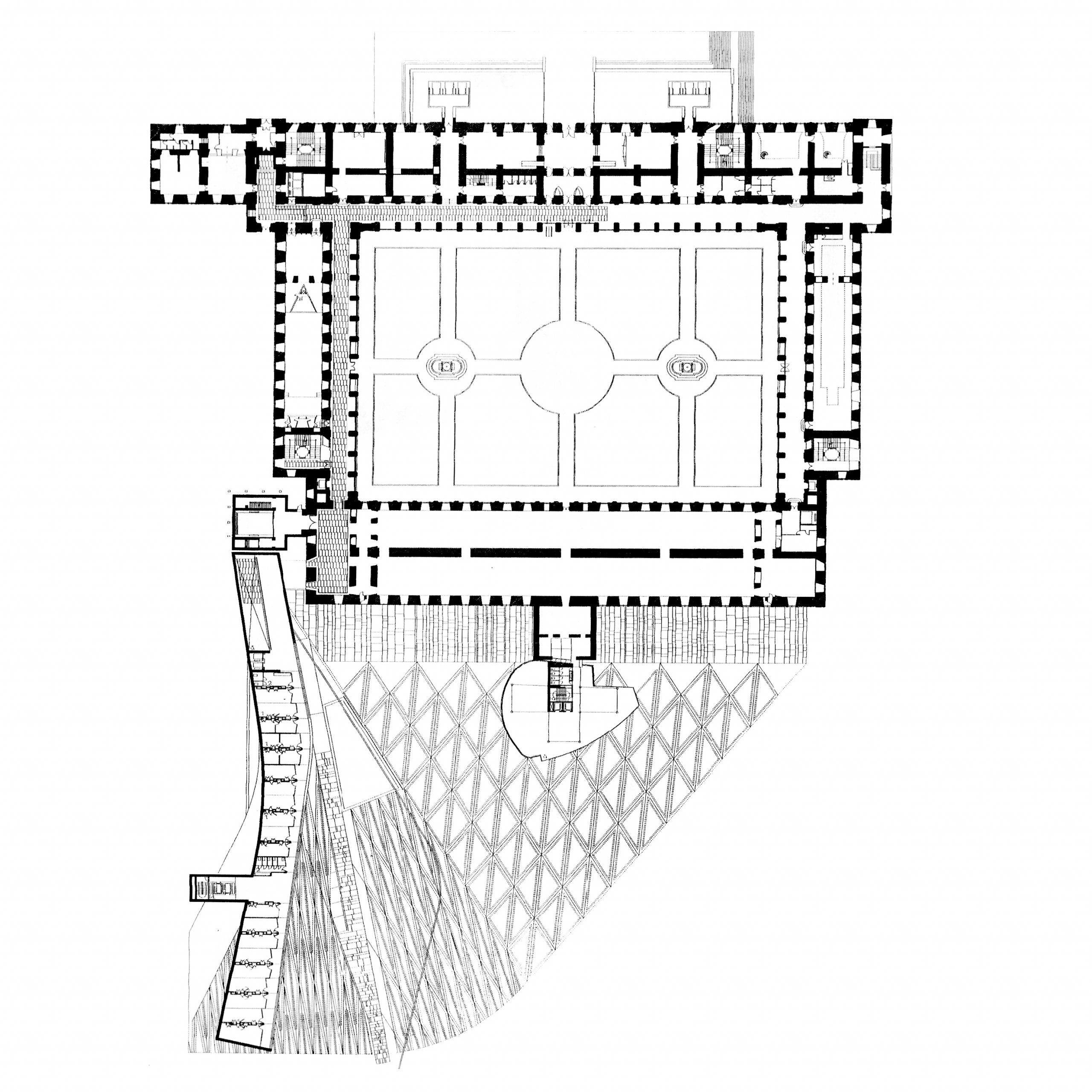
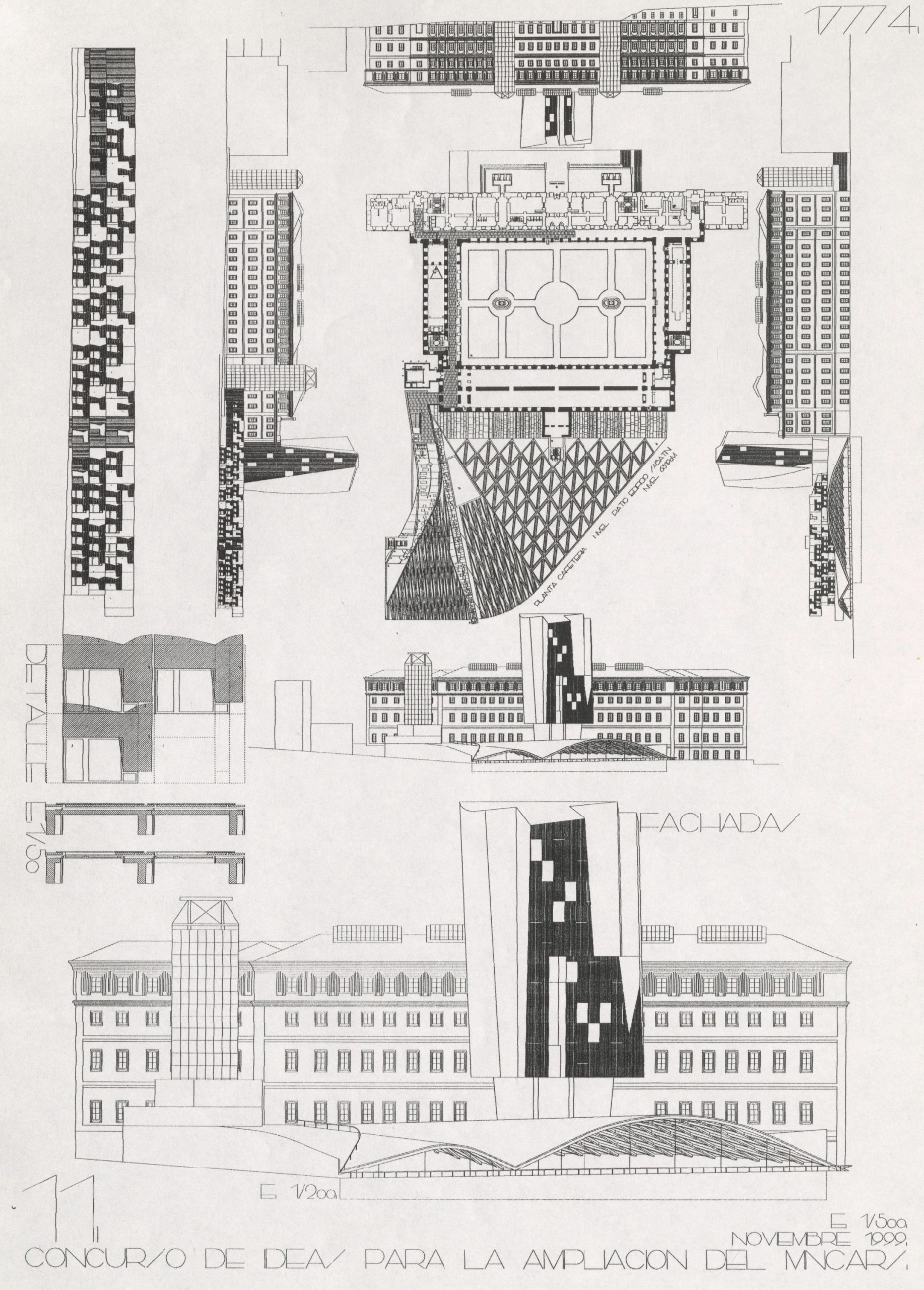
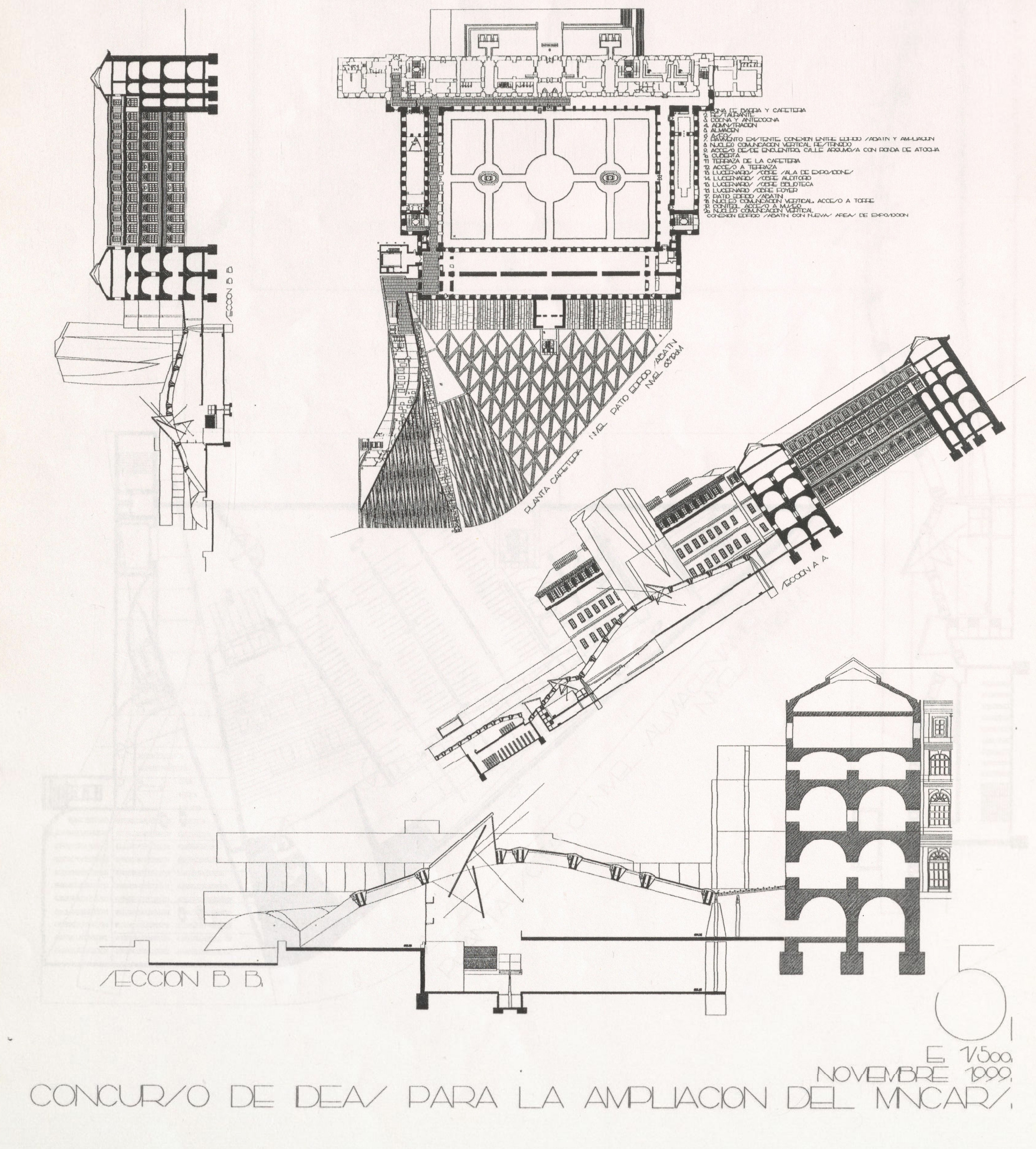
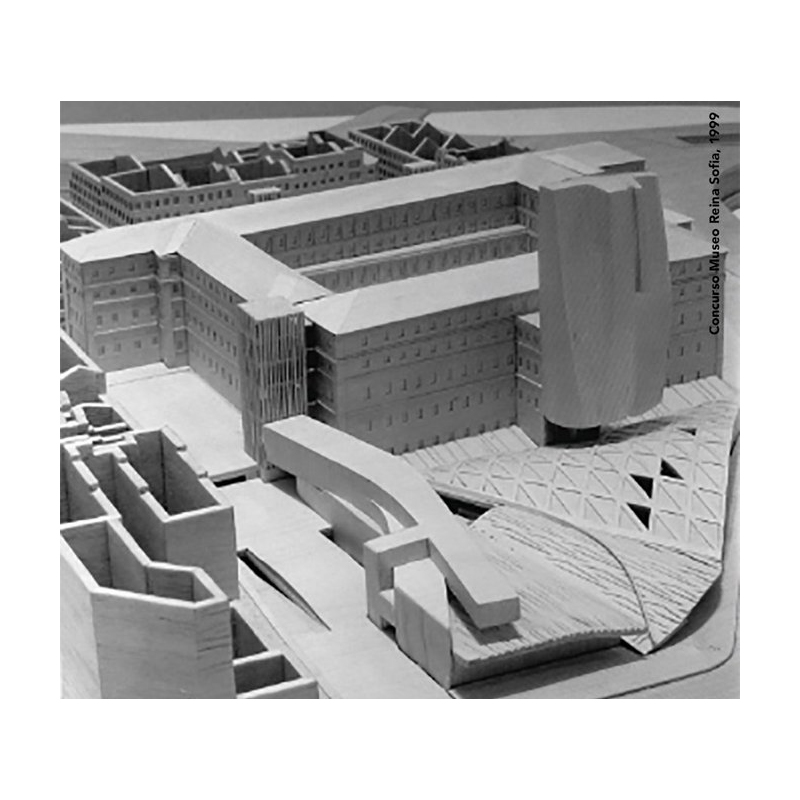
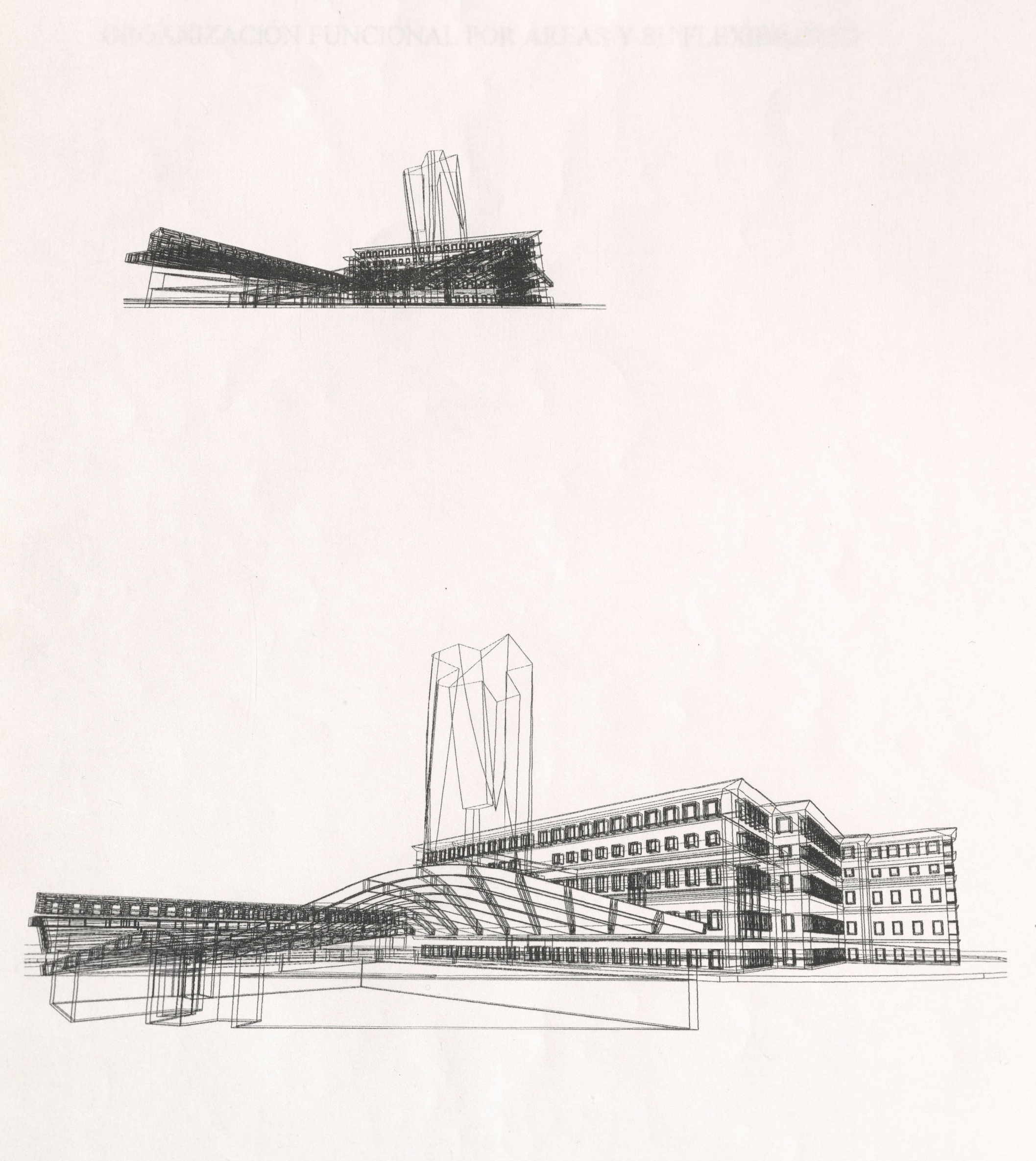
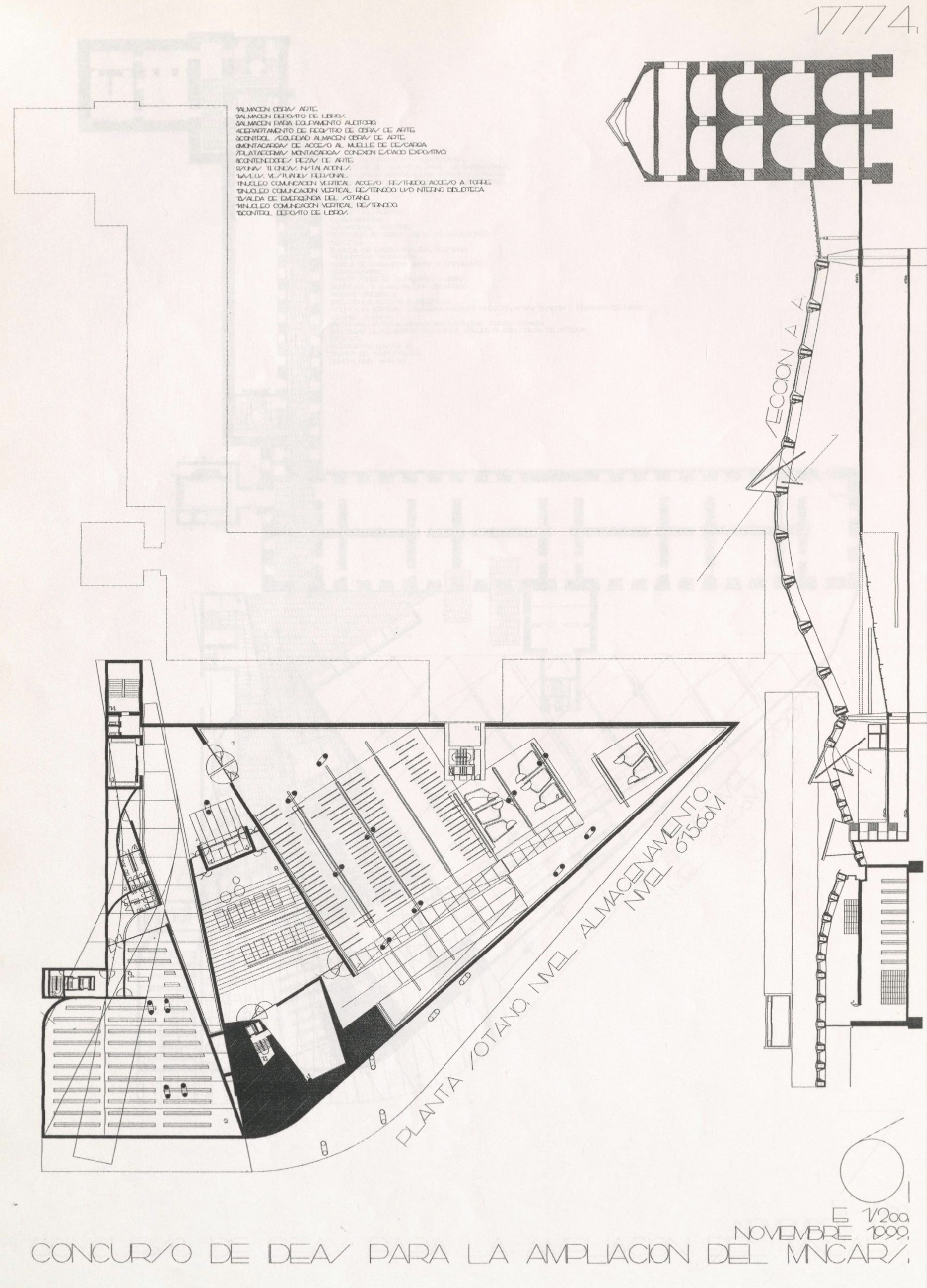
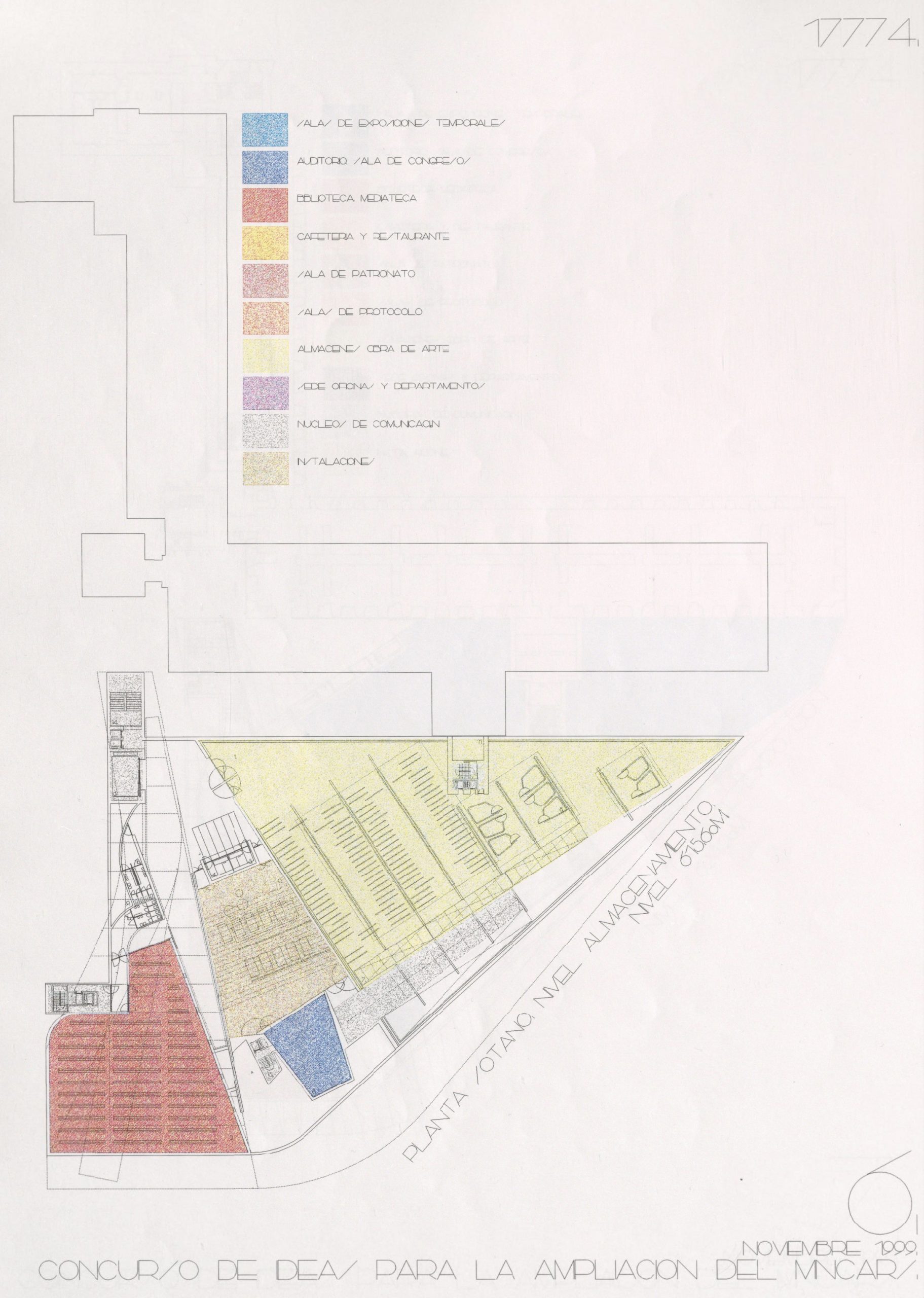
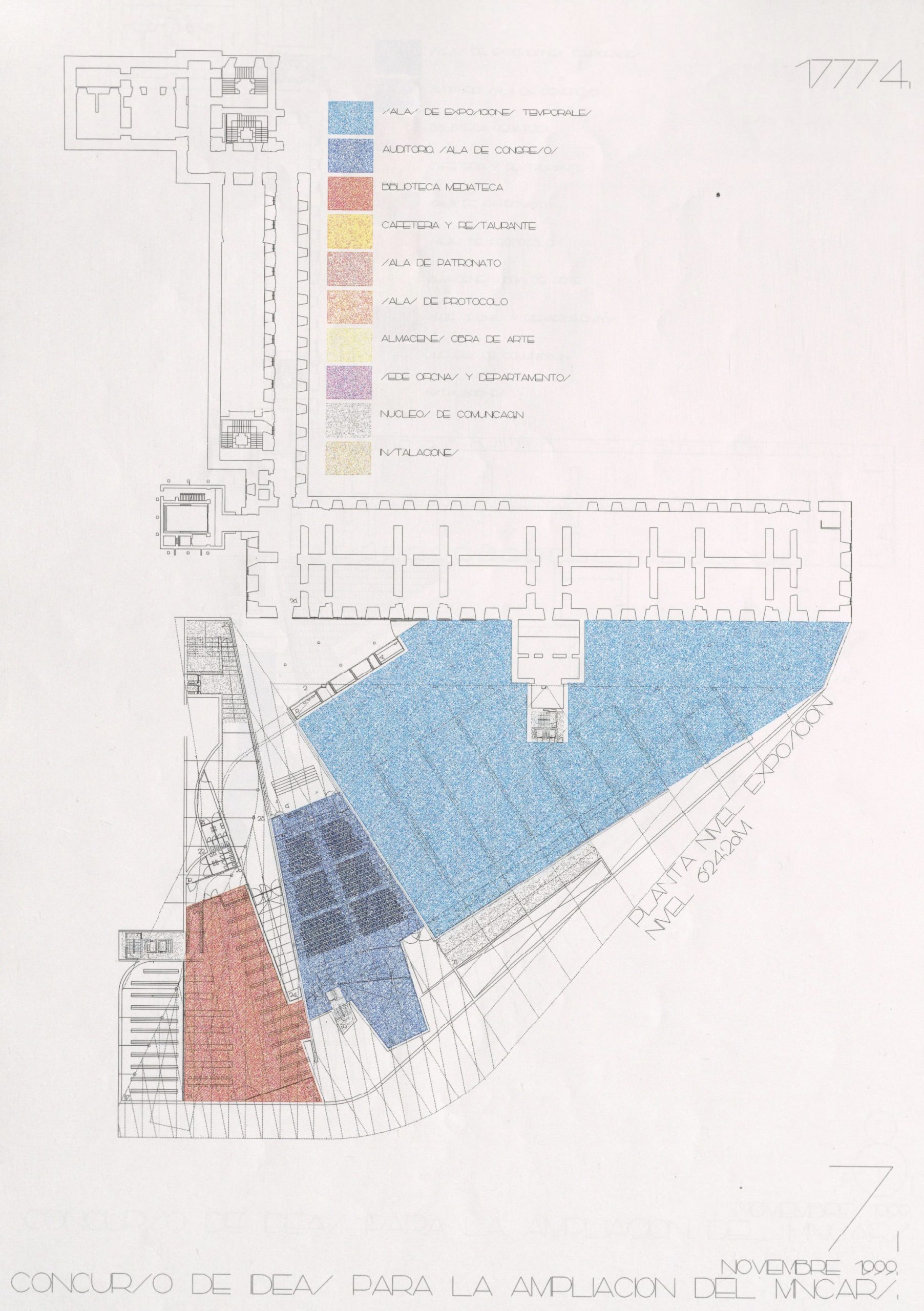
The proposal minimizes the site’s footprint,
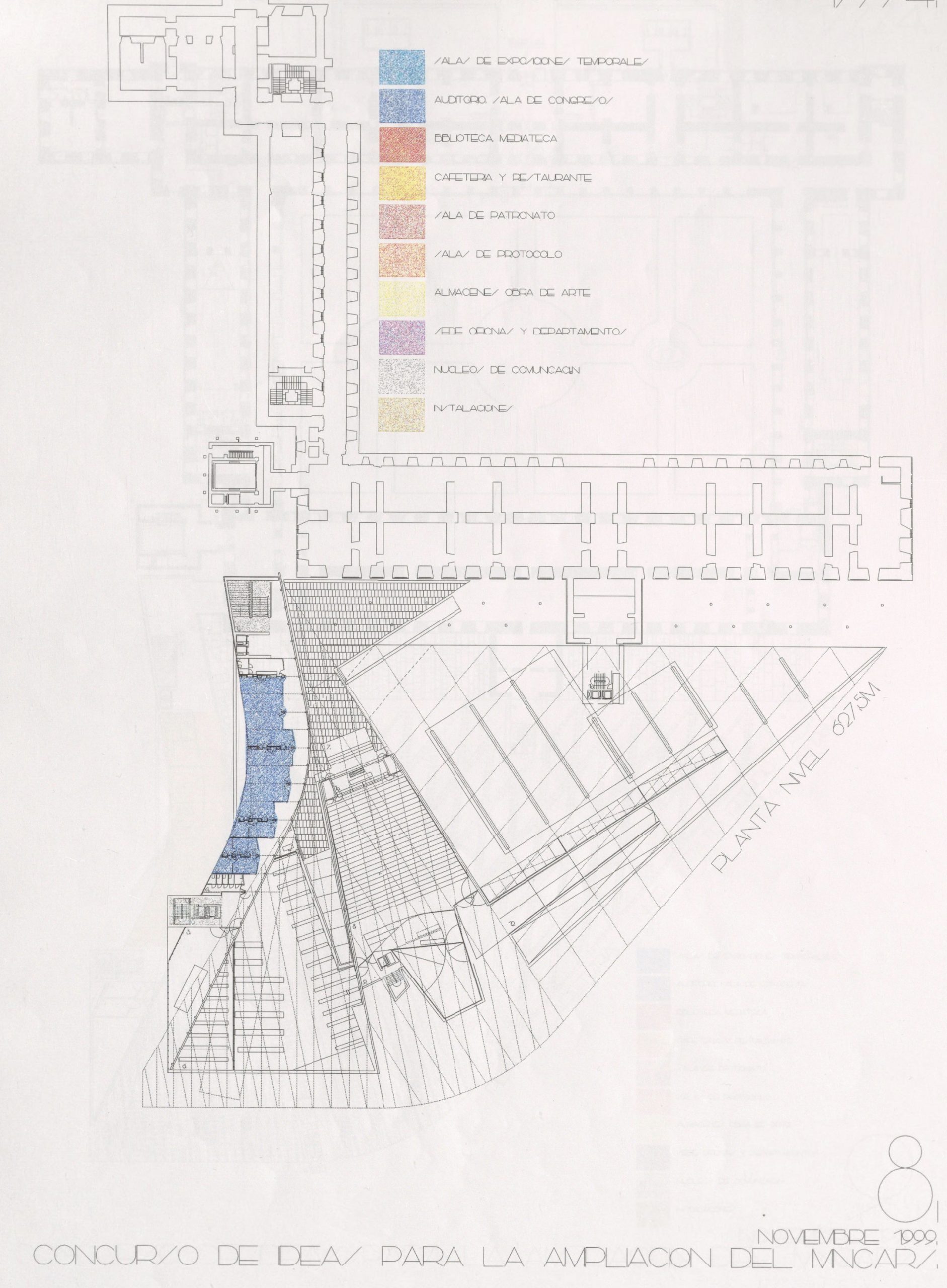
placing the large halls on a semi-underground level, so that the roof can be considered public space.
A tower supports the offices, and a small bar more public spaces,
The proposal proposes maintaining the open space
that currently exists on the site.
La propuesta reduce al mínimo la huella del edificio,
ubicando las grandes salas en un nivel semisubterráneo, de modo que la cubierta pueda considerarse un espacio público.
Una torre alberga las oficinas, y un pequeño bar, más espacios públicos.
La propuesta sugiere mantener el espacio abierto
que existe actualmente en el solar.
Three principles…
Affirmation of the Museum on the Bourbon axis.
Offering a void in the nearby city.
Offering a large, unique, and activity-generating hall… I would even consider the Auditorium and the Library as active parts of the Museum…
Why not organize an exhibition in the Library?
Isn’t a cultural testament a hesitation?
The space must be unique.
Tres principios…
Consolidación del museo en el eje de los Borbones.
Creación de un espacio vacío en la ciudad cercana.
Creación de una gran sala única y generadora de actividades… Incluso consideraría el auditorio y la biblioteca como partes activas del museo…
¿Por qué no organizar una exposición en la biblioteca
¿No es una duda un legado cultural?
El espacio debe ser único.
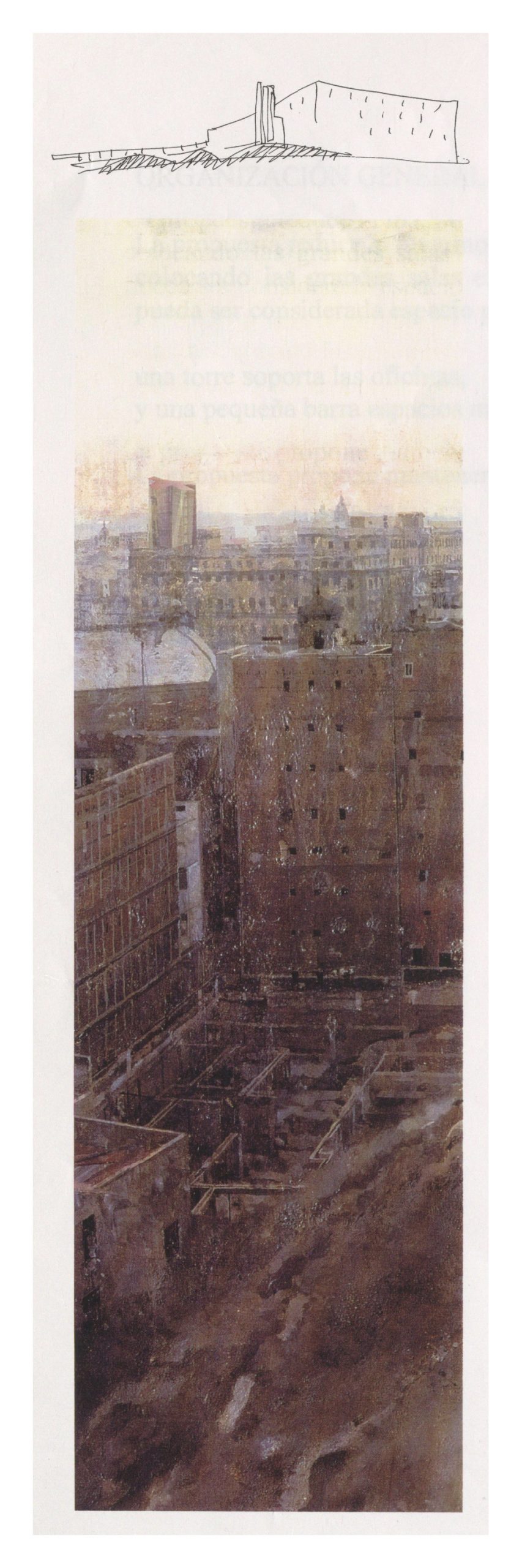
Antonio Lopez takes a long time to finish his paintings…
the city of Madrid
takes a long time to finish its buildings…
This nostalgia for an incomplete past is present in this building…
its wounds:
a construction that has not yet healed.
The former Hospital
is still present within these walls.
A very direct way of thinking lies at the origin of our proposal:
What doesn’t the Reina Sofia have?
It doesn’t have free space…
it doesn’t have a large hall
it doesn’t have the possibility of playing with emptiness.
It doesn’t have a clear strategy for how to become part of the city’s monumental axis.
It doesn’t have space in the surrounding streets.
The Museum needs real public space.
It is too large a building, the rooms are too small and identical, and the streets around its perimeter do not help to give it the importance
that the Museum deserves.
From this point of view, our work is born.
Antonio López tarda mucho en terminar sus cuadros…
la ciudad de Madrid
tarda mucho en terminar sus edificios…
Esta nostalgia por un pasado incompleto está presente en este edificio…
sus heridas:
una construcción que aún no ha cicatrizado.
El antiguo Hospital
sigue presente entre estas paredes.
Una forma de pensar muy directa se encuentra en el origen de nuestra propuesta:
¿Qué es lo que no tiene el Reina Sofía?
No tiene espacio libre…
no tiene una gran sala
no tiene la posibilidad de jugar con el vacío.
No tiene una estrategia clara sobre cómo formar parte del eje monumental de la ciudad.
No tiene espacio en las calles circundantes.
El museo necesita un espacio público real.
Es un edificio demasiado grande, las salas son demasiado pequeñas e idénticas, y las calles que rodean su perímetro no contribuyen a darle la importancia
que el museo merece.
Desde este punto de vista, nace nuestro trabajo.
This nostalgia for an incomplete past is still present in this building…
a construction that has not yet healed
its wounds…
The former Hospital
is still present within these walls.
An addition to a building must
take “time” as its working material…
that cross,
that dome…
is still there…
Better to give it shape…
reinvent the Museum’s past.
Esta nostalgia por un pasado incompleto sigue presente en este edificio…
una construcción que aún no ha cicatrizado
sus heridas…
El antiguo hospital
sigue presente entre estas paredes.
Una ampliación de un edificio debe
tomar el «tiempo» como materia prima…
esa cruz,
esa cúpula…
siguen ahí…
Mejor darle forma…
reinventar el pasado del museo.
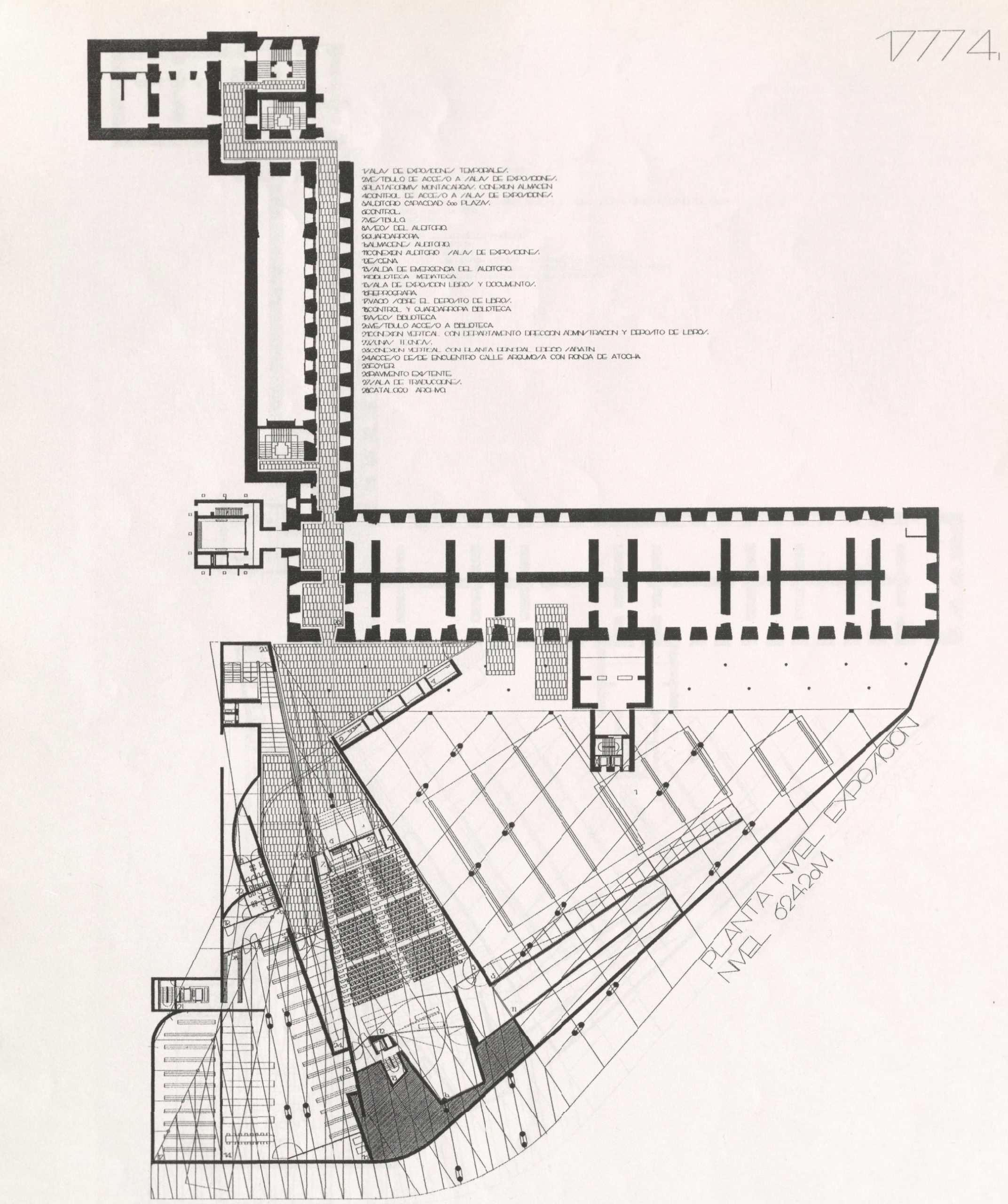
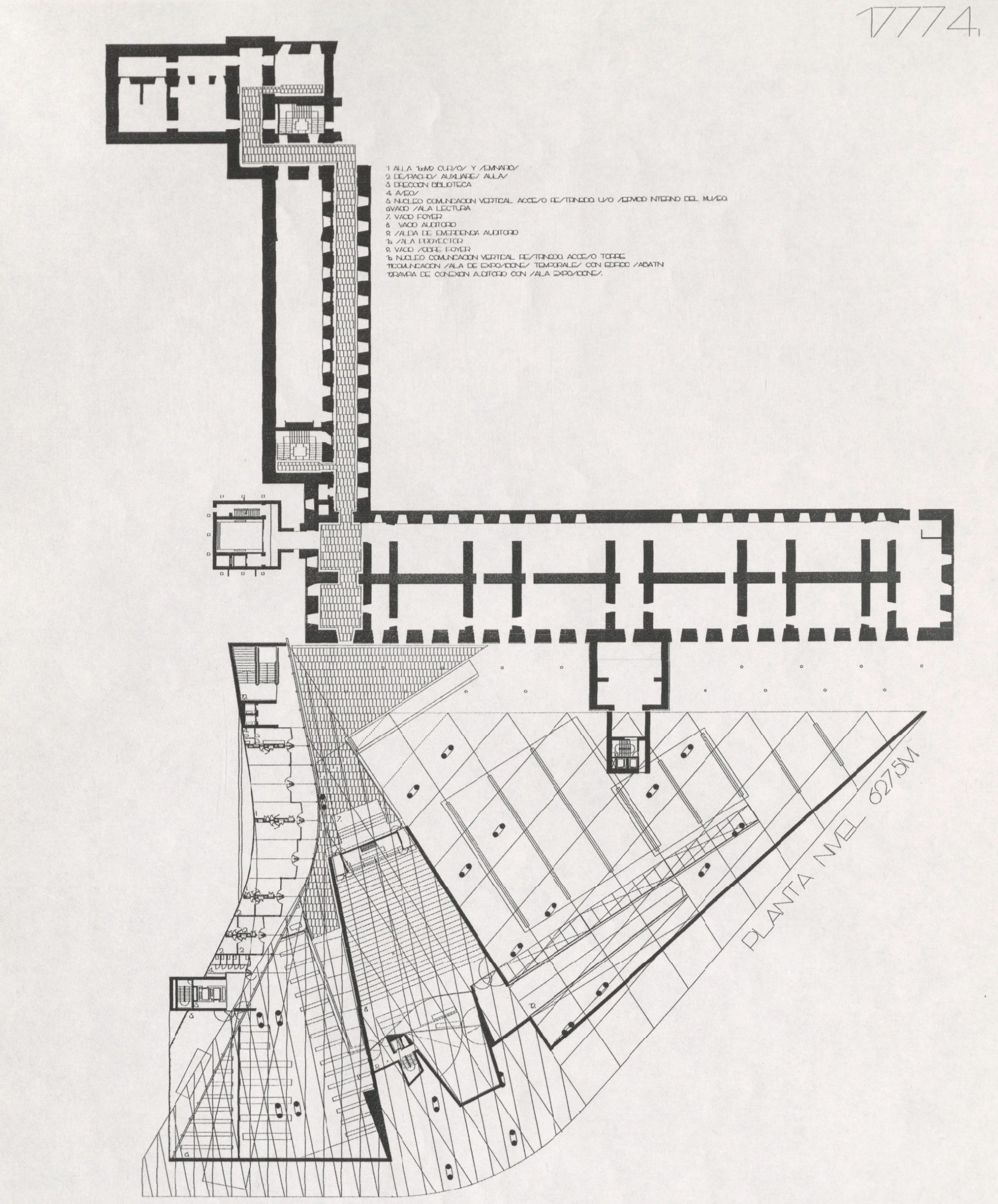
Gaining a free, unique space, avoiding the argument between museographers and architects
without pillars…
First we thought of a
Mobile Museum…
A building that could be played with…
In the end there is the large hall, which can also have some public space on its roof.
A place to practice with empty space…
Lighting and climate control are solved from floor to ceiling…
unique.
Offering a large hall… generating activities, the Auditorium and Library are an active part of the Museum.
Why not organize an exhibition in the Library?
Isn’t a talk a testimony
cultural?
The space must be unique.
Conseguir un espacio libre y único, evitando la controversia entre museógrafos y arquitectos
sin pilares…
Al principio pensamos en un
Museo Móvil…
Un edificio con el que se pudiera jugar…
Al final queda la gran sala, que también puede contar con un espacio público en su azotea.
Un lugar para experimentar con el espacio vacío…
La iluminación y la climatización se resuelven de suelo a techo…
único.
Al ofrecer una gran sala… que genera actividades, el auditorio y la biblioteca son una parte activa del museo.
¿Por qué no organizar una exposición en la biblioteca?
¿Acaso una charla no es un testimonio
cultural?
El espacio debe ser único.
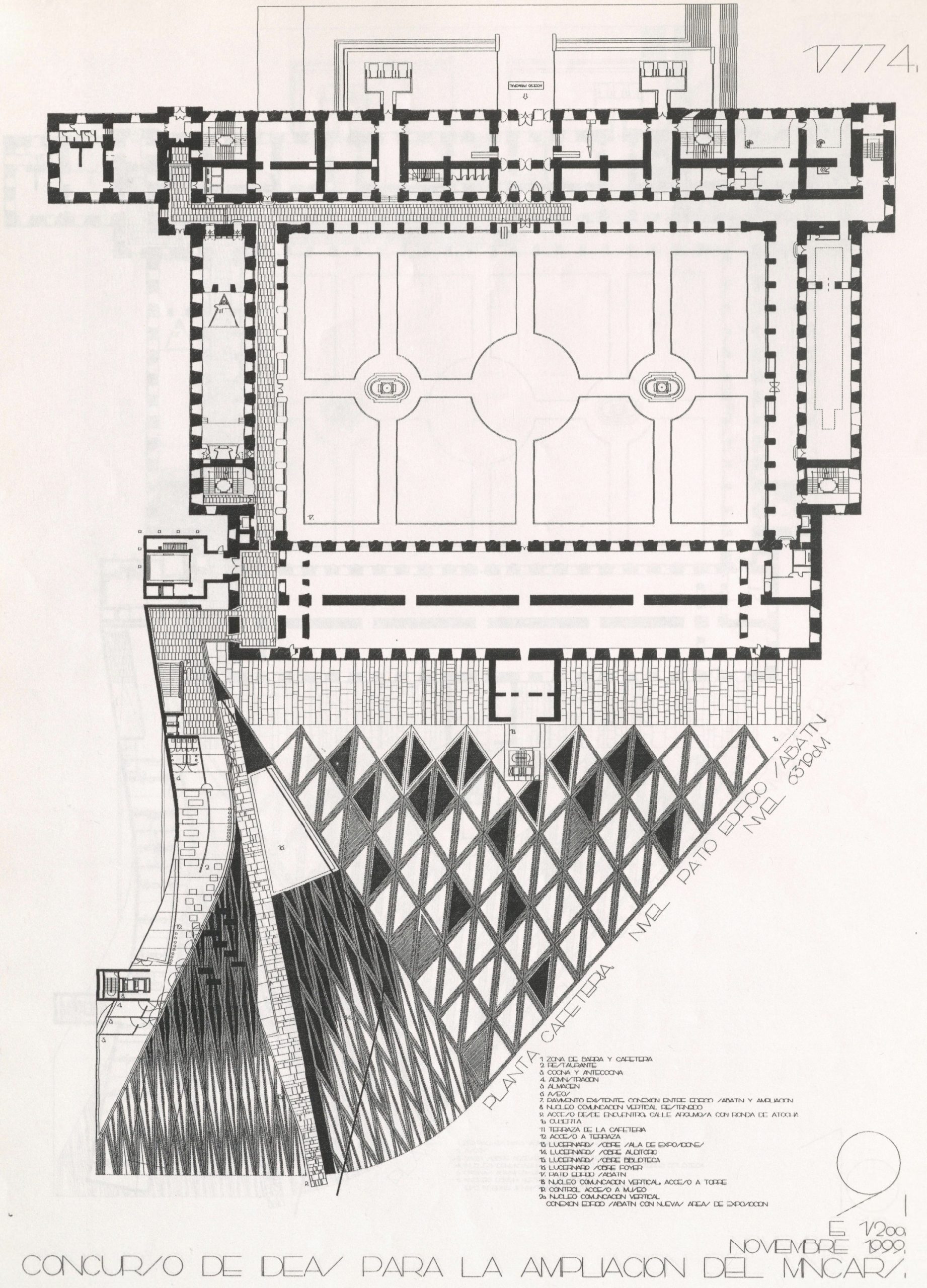
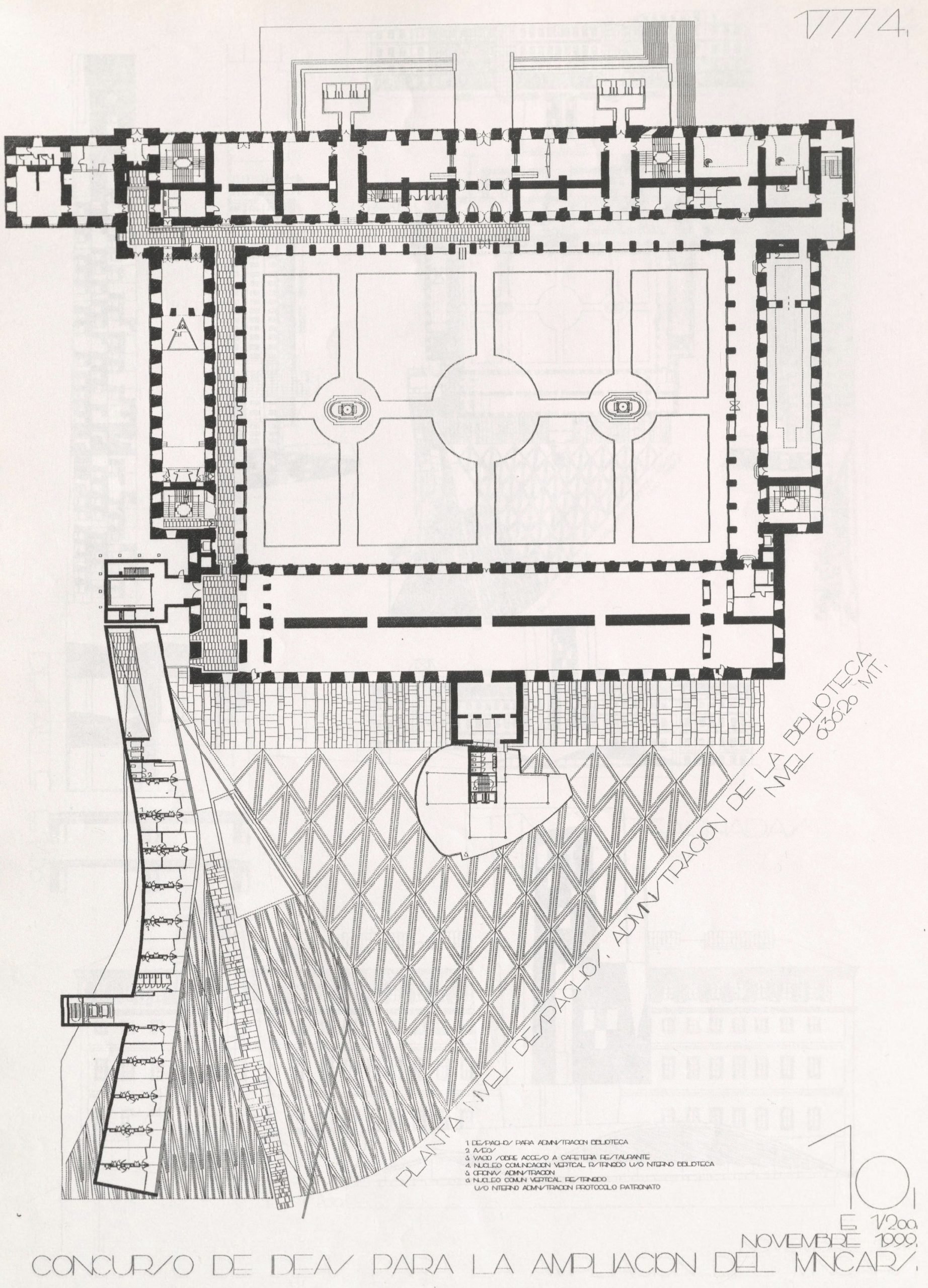
Going outside the building, but still being on the grounds of the Reina Sofia…
We had rooms and a courtyard…
too high…
This ceiling would be the floor for this
type of activities…
it’s the Reina Sofia, outside,…
in the city…
Perhaps some modification to the current courtyard would be conceivable to connect with the
extension…
and make this new Museum more
coherent.
Saliendo del edificio, pero sin salir del recinto del Reina Sofía…
Teníamos salas y un patio…
demasiado alto…
Este techo sería el suelo para este
tipo de actividades…
es el Reina Sofía, al aire libre,…
en la ciudad…
Quizás sería concebible alguna modificación del patio actual para conectarlo con la
ampliación…
y hacer que este nuevo museo sea más
coherente.
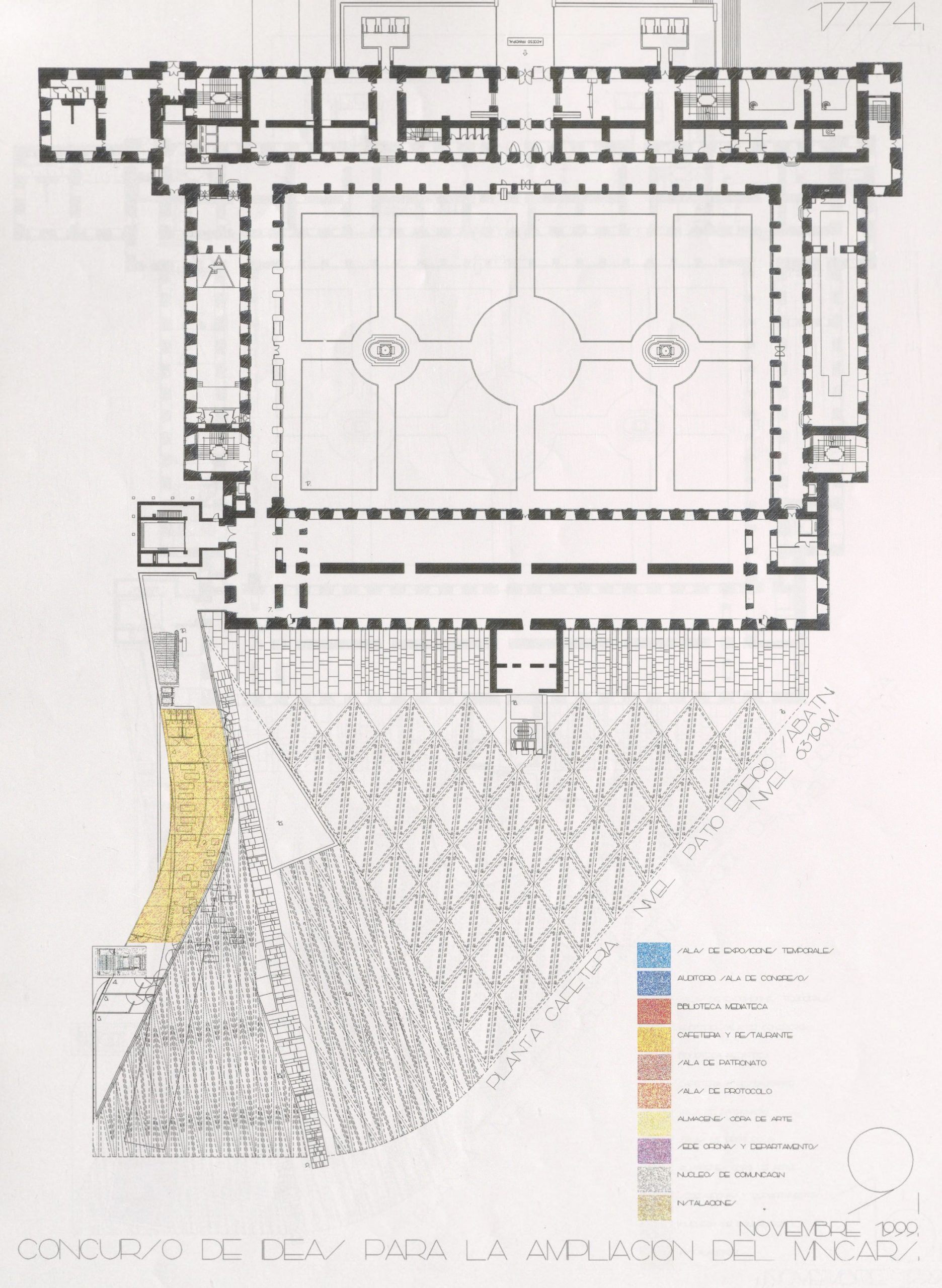
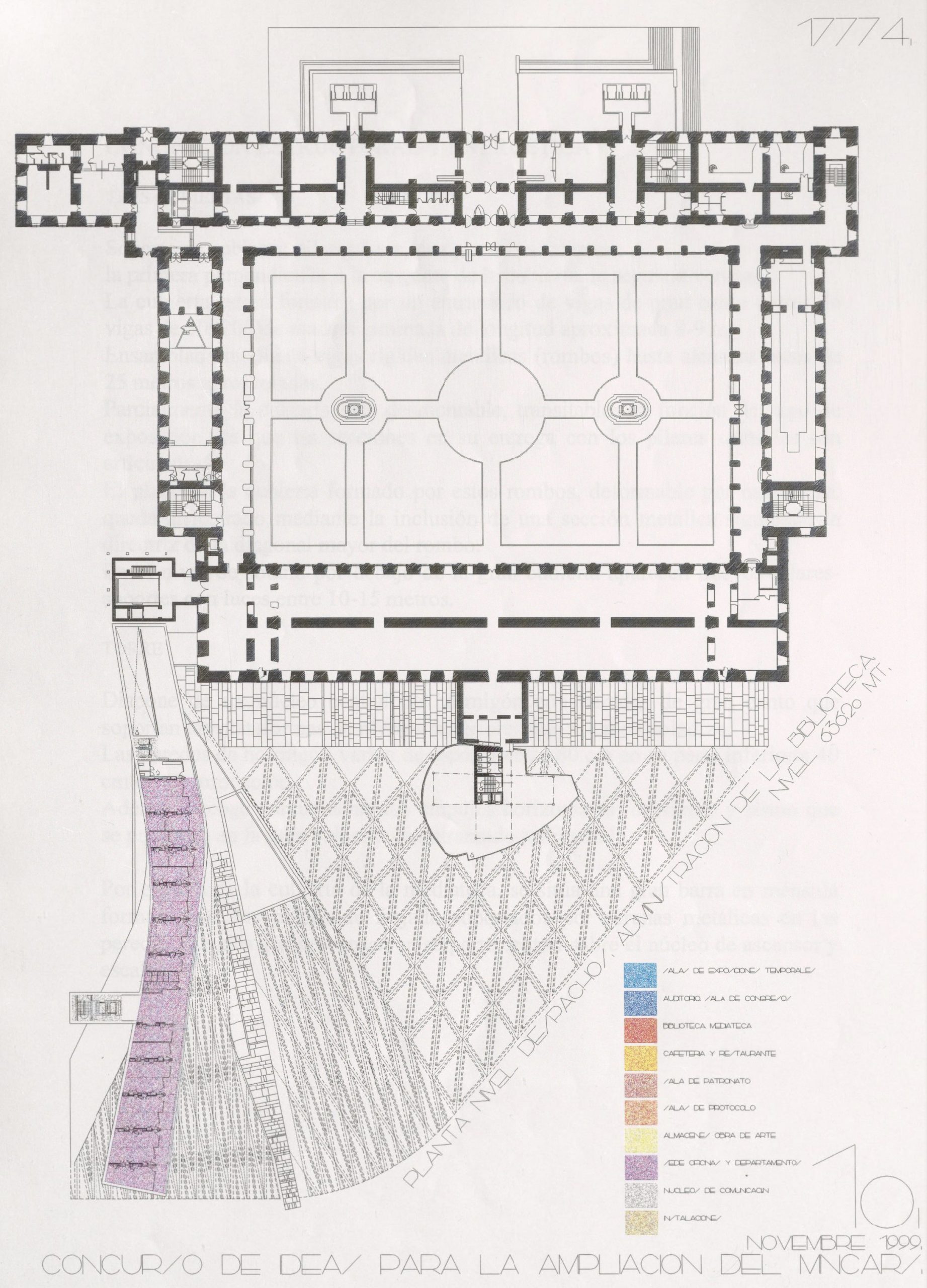
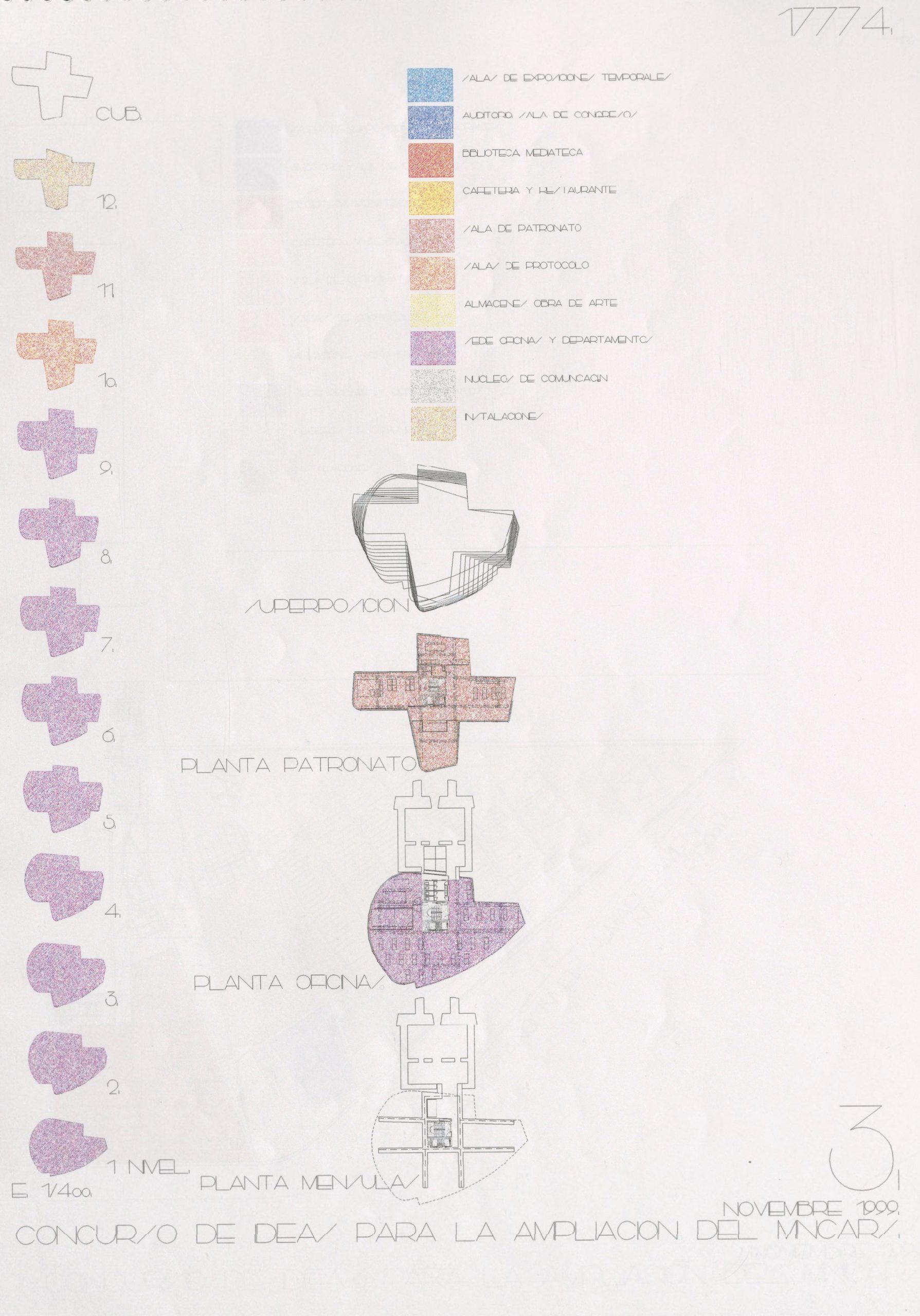
Structural and Energy Design
Diseño estructural y energético
Three Roofs
Tres cubiertas
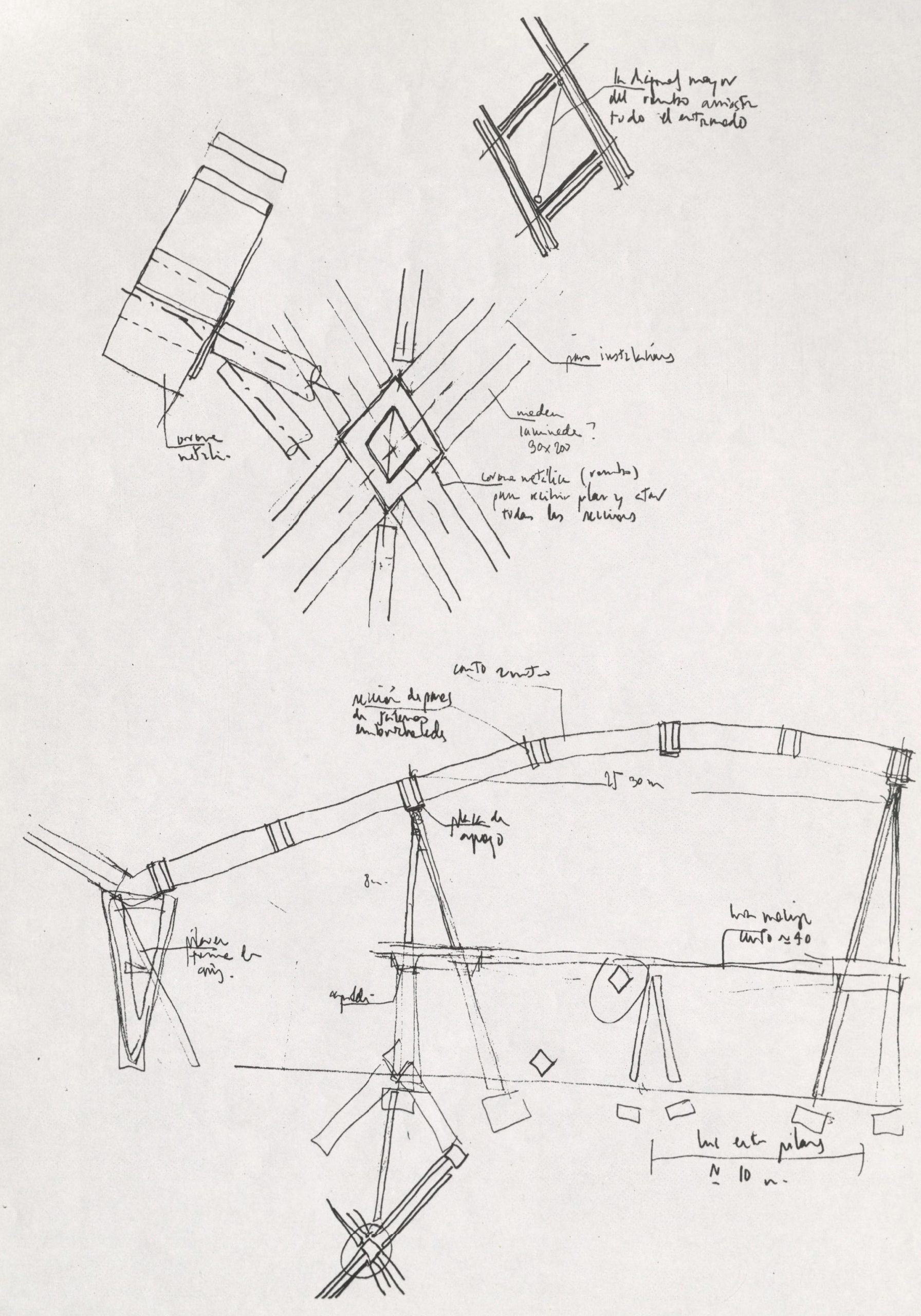
Roof support: pillars formed by two sections: the first perpendicular to the roof tangent, the second vertical.
The roof will be formed by a framework of deep beams (pairs of 30×200 beams) of laminated timber, approximately 8-9 m long. Assembled using rigid metal beams (rhombuses) to reach spans of approximately 25 meters.
Partially, the roof will be removable and walkable, depending on the type of exposure, since the sections where they connect to the central pillars are articulated.
The roof plane formed by these rhombuses, deformable by nature, is braced by the inclusion of a metal section following the guideline of the longer diagonal of the rhombus.
At the basement level, below the large roof, new support pillars appear with spans between 10-15 meters.
Soporte de la cubierta: pilares formados por dos secciones: la primera perpendicular a la tangente de la cubierta, la segunda vertical.
La cubierta estará formada por una estructura de vigas profundas (pares de vigas de 30×200) de madera laminada, de aproximadamente 8-9 m de longitud. Se ensamblarán mediante vigas metálicas rígidas (rombos) para alcanzar luces de aproximadamente 25 metros.
En parte, la cubierta será desmontable y transitable, dependiendo del tipo de exposición, ya que las secciones donde se conectan a los pilares centrales son articuladas.
El plano del techo formado por estos rombos, deformables por naturaleza, se refuerza mediante la inclusión de un perfil metálico que sigue la línea de la diagonal más larga del rombo.
En el nivel del sótano, bajo el gran techo, aparecen nuevos pilares de soporte con luces de entre 10 y 15 metros.
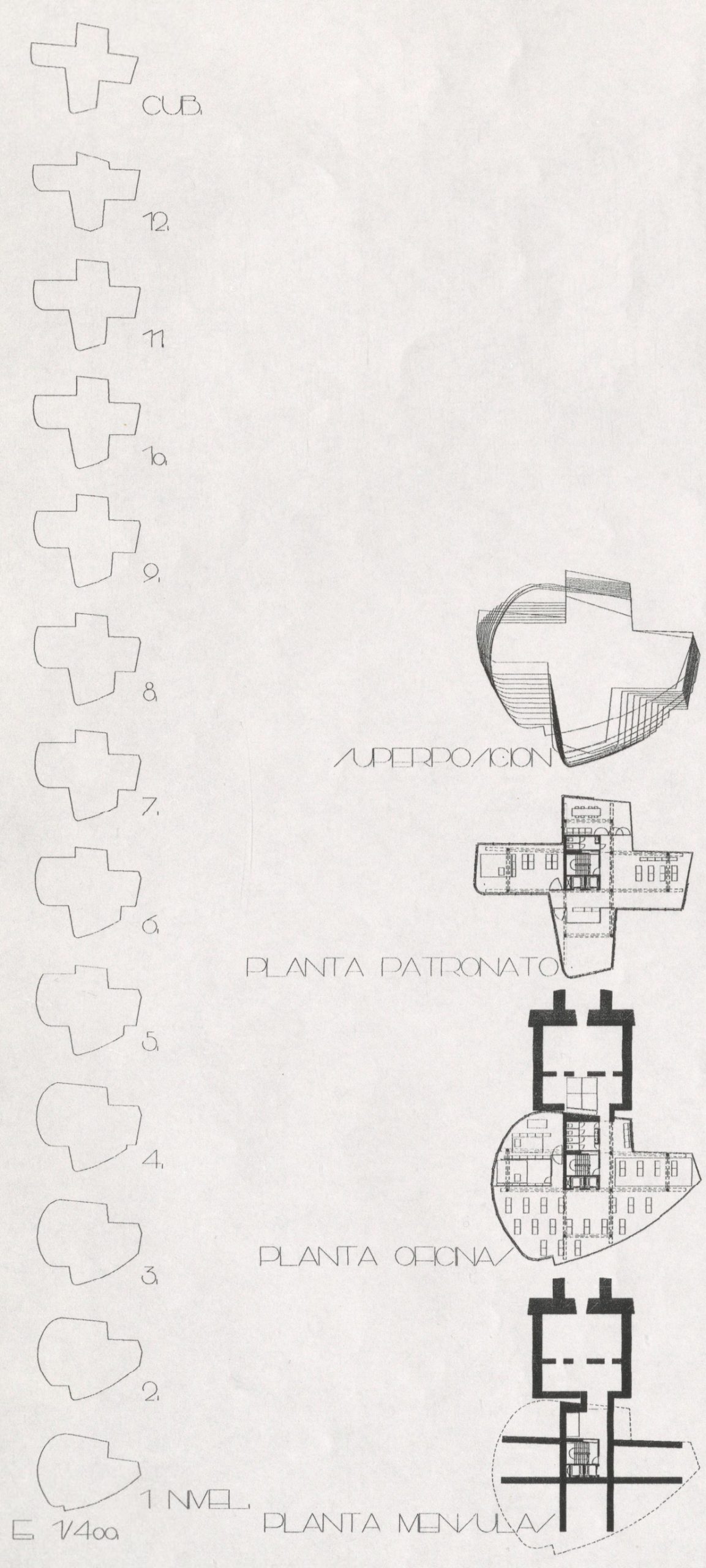
Tower
Torre
It has a central concrete core with thick walls that support the cantilevered platforms of the upper levels.
The concrete walls vary in thickness from 80 cm at the bottom to 40 cm at the top.
It also partially absorbs the horizontal wind and seismic forces generated by the large rhomboid-framed roof.
Above the media library roof is a large cantilevered beam formed by two floor slabs supported by metal trusses on the side walls, resting in their central part on the elevator and stairwell core.
Cuenta con un núcleo central de hormigón con muros gruesos que soportan las plataformas en voladizo de los niveles superiores.
Los muros de hormigón varían en espesor desde los 80 cm en la parte inferior hasta los 40 cm en la parte superior.
También absorbe parcialmente las fuerzas horizontales del viento y sísmicas generadas por el gran techo con estructura romboidal.
Por encima del techo de la mediateca hay una gran viga en voladizo formada por dos losas de forjado apoyadas en cerchas metálicas en los muros laterales, que descansan en su parte central sobre el núcleo del ascensor y el hueco de la escalera.